New twist in killing of Cecil the lion: Wildlife expert claims US dentist fatally shot the big cat DAYS before his death was discovered - and used a cynical tactic to buy time to flee Africa
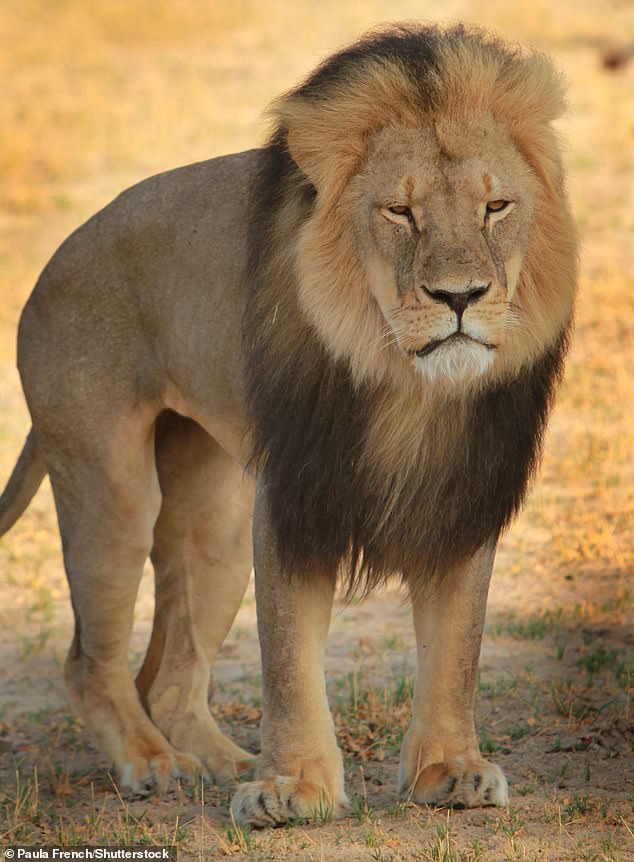
It is an image seared into public consciousness. After Cecil the Lion was lured out of a protected area in Zimbabwe's Hwange National Park and shot with a bow and arrow by an American trophy hunter, his likeness was projected onto New York's Empire State Building to recognise the global outrage over his slaughter and raise awareness of endangered species.
The display, which featured a further 160 animals, threw a spotlight on the ethics of trophy hunting and wildlife conservation, and led to Cecil's killer, a Minnesotan dentist named Walter Palmer, being vilified around the world.
Palmer, who has also relished slaughtering leopards, buffalo, moose, a white rhino, a black bear and many other species, paid £36,000 to shoot the majestic Cecil in 2015, who was being tracked by Oxford University researchers as well as Zimbabwean park rangers.
When news of his killing first emerged, an army of celebrities expressed their outrage. Model Cara Delevingne tweeted: 'This #Walter-Palmer is a poor excuse of a human being!' Actress Joanna Lumley said: 'This animal had a right to live,' while comedian Ricky Gervais posted a photo of Cecil, who was at least 12 when he died, on Twitter, adding: 'I'm struggling to imagine anything more beautiful than this.'
Ingrid Newkirk, British president of People for the Ethical Treatment of Animals (Peta), called for Palmer to be 'extradited, charged and preferably hanged', while airlines around the world banned passengers from bringing the carcasses of the 'Big Five' African species (lion, leopard, elephant, buffalo and rhino) on flights from the continent.
Now, field researcher Brent Stapelkamp, 48, who was leading the Hwange Lion Research Project, which was tracking Cecil when he was killed, has revealed the realities behind the thirst for trophy killing.
He believes that rich foreigners are exploiting Africa and breaking local laws in their thirst to hunt. He further claims that the money paid by rich foreigners who enjoy trophy hunting is dwarfed by that from tourists purely interested in photographing the animals – and often ends up in Swiss bank accounts rather than the Zimbabwean economy.
In particular, he says, hunters are breaking the law by killing underage lions, while breaching quotas of animals they are allowed to kill legally.
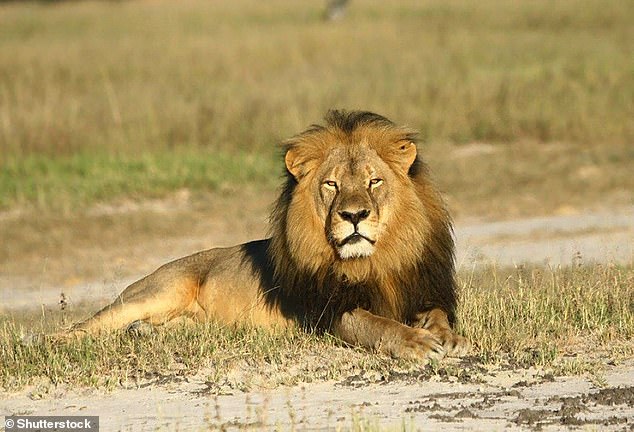
Cecil the Lion (pictured) was lured out of a protected area in Zimbabwe's Hwange National Park and shot with a bow and arrow by an American trophy hunter Walter Palmer
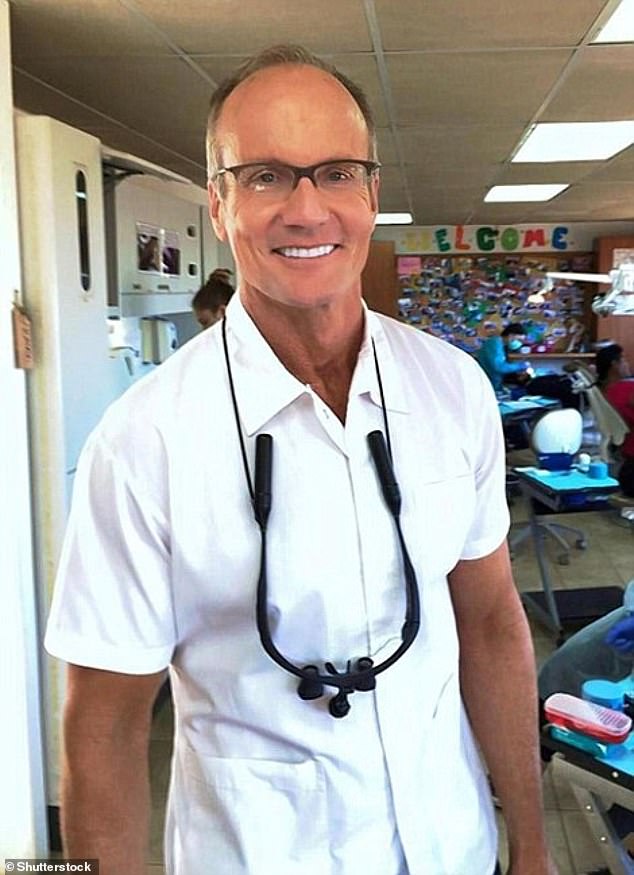
Palmer, an American dentist with a controversial history of trophy hunting, paid £36,000 to kill the majestic Cecil the Lion in 2015, having previously relished the slaughter of leopards, buffalo, moose, white rhino, and black bears
According to the documentary, an estimated 36 million tourists went on safari in Africa in 2022, spending some $175 billion (£128 billion)
Speaking on the Channel 4 programme Cecil: The Lion and the Dentist, which airs tonight (Thursday), he said: 'In Zimbabwe, very rarely does a lion get to mature, like Cecil did. The fact that Cecil got to twelve [sic] was just because he was deep in the park, with a lot of prey. And he had two prides of lionesses, with cubs. He was still breeding.'
According to the documentary, an estimated 36 million tourists went on safari in Africa in 2022, spending some $175 billion (£128 billion). Yet little of this money seemingly reaches local communities. Meanwhile, trophy hunters have killed at least 374 lions in Zimbabwe since 2015 – one of them being Cecil's son Xanda.
'I remember seeing a calculation about how much money Cecil would bring to this park every day in the prime [tourist] season, based on how many clients would see him,' says Stapelkamp. 'It was something ridiculous like $50,000 a day (£36,000. He was that popular.'
Yet Stapelkamp, who has since left Hwange and lives in the bush, says that trophy-hunting brings much less to the local economy than simply observing the animals on safari. 'To shoot a lion legally in this country is about $100,000 (£72,000) and that money is going to Swiss bank accounts. It's not even coming to the Zimbabwe economy. It's certainly not going to the people living on the boundaries [of the national park].'
Stapelkamp believes that trophy hunters breached the law by shooting Cecil in 2015. 'In Zimbabwean law, the [minimum] age limit for hunting Hwange lions is six years old,' he explains. 'That gives the maximum chance that every lion shot will have sired and raised one cohort of cubs to adulthood.
'But in 2014, out of the five lions hunted, four of them were under the age of six. One was twenty-two months, I think. So, the penalty for that would be no quota [of lions to shoot legally] the next year. So, there were no lions on quota in 2015 [when Cecil was killed].'
Stapelkamp, who was born in Zimbabwe, began working at the 14,650 square-kilometre Hwange park in 2006 and was responsible for collaring, tracking and studying its lions. He attached a GPS satellite collar to Cecil in 2013, which uploaded the lion's movements every two hours to a database.
'I do think there is a primal need that hunting satisfies in some people, and I've got no problem with hunting to eat,' he says. 'It's the trophy aspect. There's no African context for trophy hunting, never was. It was introduced by rich foreigners, coming to exploit.'
In the course of his work, Stapelkamp met many trophy hunters excited by their kills, including a man who legally killed a lion named Oliver, after Stapelkamp's own son. 'As field researchers, we would get a phone call to say: 'Come and get your collar and meet the hunter that has just killed Oliver the lion. He's all excited. He's killed the lion of his dreams. He's high on life.'
'To be professional, I shook the hand of the man who just killed Oliver and watched how they skinned him ... When that animal's trophy gets back to wherever it's going, it can be taxidermised, made to look fierce and stuck on his wall, like he challenged this lion with his bare hands.
'The hunter's standing there in his camouflage, big smile on his face. He's asking me: 'Can we have the GPS downloads? We'd love to show our family where this lion used to walk.'
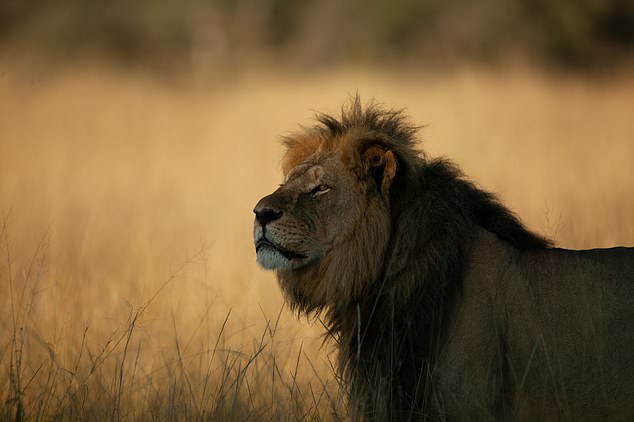
During peak season, Cecil was the park's main event. Based on his visibility to clients, he was reportedly generating a staggering $50,000 (£36,000) a day
Celebrities including Cara Delevingne, Joanna Lumley, and Ricky Gervais expressed widespread outrage following the 2015 killing of 12-year-old Cecil, with Delevingne labelling hunter Walter Palmer a 'poor excuse of a human being'
Stapelkamp has vivid memories of the day that Cecil, who was named after the British mining magnate Cecil Rhodes, was killed. Cecil had been lured out of the safety of Hwange national park, which is bordered by a 140-kilometre railway track, by an elephant carcass that may or may not have been deliberately placed there.
After being hit in the flank by an arrow fired by Palmer, he ran off into the bush, hurt and terrified, while the hunters and their guides, including Palmer, returned to their camp to wait for first light. Horrifically maimed, Cecil managed to stay alive overnight. But he was eventually run to ground by the hunters, who approached him and shot him dead.
'Hwange is fully protected but whenever you saw lions heading for the railway track, you always had a knot in your stomach,' he says, 'because [the lion has] full protection on this side [and can be] hunted legally the minute they cross those tracks.'
Stapelkamp describes the morning he learnt Cecil had been killed. 'I was making coffee, and I checked Cecil's data [online]. And I remember seeing a GPS point for 8am, and then nothing later. I thought: 'Well, that's strange.' Just after 12pm, still no point [on the GPS]. After a few of those, now you start to worry. You think: 'Well, either the collar's died or something's happened to the lion.'
'For maybe a day or two, Cecil had been feeding on this elephant, and [I suspect] word had got out to the hunters. I believe [Palmer] wanted the [biggest] lion, and Cecil was thought of as the biggest.'
Difficult though it is, Stapelkamp imagines the moment Cecil was shot. 'A bow is quite quiet. So, there would have been a 'zonk' and 'huh'. And Cecil would have run off, wounded. He's exhausted; he's bleeding out, slowly, maybe his lung's collapsed. And that's why they [the hunters] say: 'Let him feel it, let him fight off hyenas. Leave him the night. Let him feel it, let him bleed.'
'[The hunters] head back to the lodge, at 10pm, full of enthusiasm. And imagine the energy – he's just shot the world's biggest lion. In July, the sun rises a bit later. By 7.30am, it's fully light. And the hunters find him very easily in the morning and finish him off.'
Despite the fact that Palmer never faced charges, and his guide Theo Bronkhorst, who founded Bushman Safaris, was cleared in court, Stapelkamp is convinced that it was an illegal hunt because he believes no lions should have been shot at all in 2015 after so many underage lions had been killed the previous year.
He believes that Palmer and his guides would have escaped any scrutiny for killing Cecil had it not been for the lion's collar, which was tracking his movements. Stapelkamp even suggests it's possible that Palmer might have shot and killed Cecil several days before(ital) the collar stopped broadcasting the lion's whereabouts - and that his guides may even have enabled a delay to give Palmer time to get out of the country and avoid prosecution.
'What I'm suggesting, and what we have evidence for,' he says, 'is that when they had finished the lion off and approached Cecil's carcass, Walter Palmer spots the collar in the mane for the first time and panics.
'And I believe that [his guide] Theo Bronkhorst thought: 'These lion research guys are watching this collar, we're going to get caught. So [Bronkhurst said to local rangers]: 'Here's some money, walk [the lion] around, pretend it's alive, while we get the client out of the country – and [the park authorities] can [track] it on the satellite image.'
'The lion – or the collar, dressed as a lion – goes to the waterhole to 'drink', 'walks' the perimeter. It goes under a bush and does that for close to two days. And then Cecil's collar stopped sending data.'
He adds: 'There's a lot of very powerful people involved in the hunting industry in this country. So, I can only imagine that the hunting industry, after the initial shock, gathered themselves, went to National Parks and said: 'If we still say that this was [an illegal] poaching incident, no-one is going to come and hunt in Zimbabwe. Then we're going to lose our hunting industry.' So, on the flip of a dime, it was legal in the end ... The case is dropped.'
Bronkhorst told the programme: 'The truth is, if we were guilty of breaking the law, I would have been in jail. I would have been found guilty, and I never was. It was kicked out of court. We, we were well within our rights. We did it all legally.
'I had been contacted by an agent, and he asked me for a good area for a bow hunt. A number of good males had always been taken along there, and that's why I went there. We were probably about a kilometre from the park boundary.
'The lion was on an elephant carcass from a previous hunt. With a lion, you've got to be within 30 yards to shoot it. You're not going to do it very easily on the ground. So, we decided to go with the tree blind. Just before dark, we went up into the blind. Checked the client's bow was alright.
'They knew we were sitting there. But by sitting quietly, eventually they settled down, and that's when we shot the lion. No professional hunter worth his salt would follow wounded animals, dangerous animals at night, even with a gun. A lot of bow hunters want to claim the kill for themselves. It was his wish to kill his own animal, so I respected that.
'After we had shot Cecil, we obviously took our photos. And then the client contacted his secretary and asked her to change his flight, because he had got the only animal he wanted.
'I think I was in the right place at the right time, with the right lion, with the right name, to create a media storm like we've never seen before. I was just overwhelmed. And unfortunately, perception is reality. And I was perceived to be this horrendous person, and the world believed it. And what the media put out there was absolutely wrong. It couldn't have been further from the truth.
'Soon after Cecil, the professional hunting community turned against me. I was basically told that I had messed up the industry. I felt that was very tough. I pleaded with them to back me up, and they wouldn't.'
Regarding the movement of Cecil's tracker, Bronkhurst admitted to moving it after Cecil's death, but said that he'd left it hanging on a tree.
'The truth is, I left it at the carcass. And then I picked it up later, moved it down, drove around with it for a while. And then I left it at the, at the bottom waterhole, near the railway line. And then I came back into camp that evening. Then I went back, and the collar was gone when we got back there. And I presume that a hyena or something had...because I'd hung it right next to the bait, and that's all I can think of that had happened to it.'
Palmer declined to take part in the programme but has claimed in the past that he didn't know that Cecil was collared because they were hunting at night. 'If I had known this lion had a name [Cecil] and was important to the country or a study, obviously I wouldn't have taken it,' he said. However, he continues to trophy hunt. In 2020 he reportedly travelled to Mongolia to legally kill a threatened ram.
Cecil: The Lion and the Dentist is on Channel 4 at 10pm tonight.
Related Articles