Oxford University has been criticised for its failure to act over a bearded lecturer who has been wearing giant fake breasts to teach.
Sex Matters, the gender-critical advocacy group, said it appeared no one at Oxford had questioned whether Matt Rattley's actions 'might amount to harassment of female students'.
It said there is 'no evidence' he identifies as a woman, and called on the university to 'call time' on 'inappropriate' behaviour.
The lecturer in biochemistry at St Hilda's College has already attracted online controversy due to his bizarre appearance, which also involves wearing women's clothes and makeup.
And last week it emerged three college graduates including a leading clinical psychologist have written to St Hilda's over concerns that Mr Rattley's behaviour 'violates women's dignity', and that it would be 'reasonable for them to feel that it creates an intimidating, hostile, degrading, humiliating and offensive environment'.
St Hilda's has received at least three formal letters of complaint, including one from the parent of a current undergraduate, with some alleging that the situation amounts to sexual harassment against female students and teachers.
Mr Rattley, who was appointed a non-stipendiary lecturer in 2023, has posted pictures of himself on social media wearing the prosthetic breasts with low-cut tops.
Fiona McAnena, director of campaigns at Sex Matters, said: 'It is unlikely that lawmakers ever intended to normalise and protect a bearded man wearing giant fake breasts to teach young women at university.
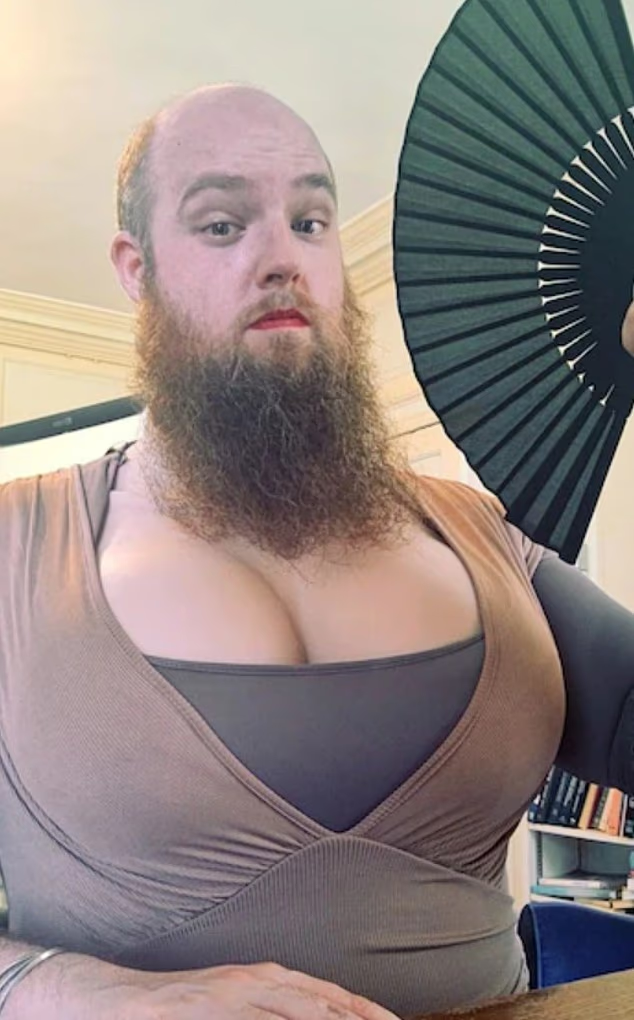
Oxford University has been criticised for its failure to act over a bearded lecturer who has been wearing giant fake breasts to teach students. Pictured: Matt Rattley
'But it seems that no one at Oxford University has questioned whether his behaviour is appropriate, whether it might amount to harassment of female students, or simply make them feel uncomfortable.
'There's no evidence that this man identifies as a woman, but transgender demands muddy the water so that normal standards of behaviour are undermined, and those in positions of authority who should know better do not intervene for fear of upsetting the transgender lobby.
'The impact on women doesn't seem to feature.'
Oxford has said that it does not comment on 'individual personnel matters' and that any students with concerns need to go through the 'established University or college procedures'.
But Ms McAnena added: 'If, as the university statement claims, it aims to be a place where "all members of our community feel respected", then its leaders should call time on behaviour that many female students and academics are likely to find insulting and inappropriate, and show that they have some respect for their female colleagues and students'.
At the weekend, an Oxford academic who attended training events alongside Mr Rattley told The Mail on Sunday: 'I was due to attend a series of staff training sessions at Oxford with Mr Rattley. I ended up missing most of them because I found being around him so distressing.
'At the first session, he was giving a presentation. I was in the front row, so those big prosthetic boobs felt like they were in my face. I didn't know where to look.
'The worst part was that other people were behaving as though he was dressed normally. You're sitting there thinking what you're seeing is hideous and disrespectful, while everyone around you is pretending it's OK. It makes you doubt your sanity.
'Another session I attended was during the summer heatwave. Rattley was sitting with his legs apart in a miniskirt, with his underwear visible, flanked by two admiring young women - in long dresses.
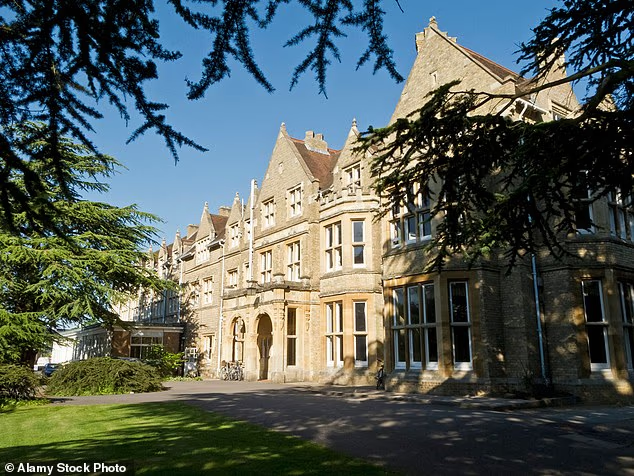
Sex Matters, the gender-critical advocacy group, said it appeared no-one at Oxford had questioned whether Matt Rattley's actions 'might amount to harassment of female students'. Pictured: St Hilda's College
'Many of the female staff fawn over him. He's pretty intimidating because, even without his high heels, he's a very tall, imposing man.
'It does feel like sexual harassment. You feel as though you're being forced to participate in someone's sexual fetish without being given a choice. It's like being forced to watch porn. You either comply or feel you're risking your job by objecting.
'After the training, I sent the organisers feedback, asking how they would respond if the female trainer they hired for the event wore a "strap-on" penis'.
Another Oxford lecturer said that students and academics fear speaking out.
'Oxford people are very reluctant to speak out in public about Mr Rattley, because although the University is pretty good about free speech in the abstract, it comes down hard on anyone who says anything about another identifiable member of the University,' she said.
'I privately asked a fellow at St Hilda's what, if anything, they were doing about this. She said that, as far as she knew, no student had complained, and unless and until that happened, it was very unlikely that the College would do anything.'
A former student at the college said: 'This case is one that really troubled me throughout my time as a student and that I continue to find disturbing and disillusioning.
'At first, I thought it was a joke—fancy dress. But this is everyday attire. His prosthetic boobs are enormous, exaggerated and cartoonish.
'Had I been an undergraduate in his class, I know I would have felt very conflicted and deeply uncomfortable. I'd also have felt guilt for thinking negatively of someone whose internal state I simply couldn't know. I certainly wouldn't have made a formal complaint.
'I have spoken about this at length with trusted friends and family who agreed the situation is outrageous, but it never felt like an option to be open and public about it because any concerns would inevitably be received as bigotry.'
Meanwhile, one of the signatories to the letter, the distinguished clinical psychologist Dr Lucy Johnstone, said the college's failure to act so far was concerning.
'I haven't met Mr Rattley so I can't be certain what is going on here. But as a psychologist who has worked with women clients for many years, I do know that in all forms of harassment and abuse, you see denial by the perpetrator, silencing of the victims, and often collusion by institutions.
'But there seems to be an extra twist here,' she continued. 'If accepting an offensive behaviour is presented as progressive and open-minded, it is even harder for women to name what is really going on and speak up about it.
'I cannot understand why the college and the university are apparently unconcerned about possible breaches of boundaries and conduct. I am particularly disappointed that a college set up with women's needs and women's education in mind seems to be failing so badly in offering women basic protections.'
And according to a leading employment barrister, St Hilda's has placed itself at serious risk of legal action.
'It is difficult to see any sensible basis on which it could be argued that his conduct was not sexual harassment of all students and colleagues who come into contact with him,' said Naomi Cunningham from Outer Temple Chambers.
'St Hilda's' willingness to prioritise male sexual entitlement over staff and student wellbeing by condoning Rattley's antics is dismaying. The fact that no-one has yet complained is testament to what a toxic environment has been created for women (in particular) who stand up to this kind of misbehaviour.'
In 2023, Ms Cunningham represented Sandie Peggie, the Scottish nurse who won two employment tribunals against the NHS for allowing a transwoman (born male) to undress alongside her – and then suspending Ms Peggie when she complained.
St Hilda's was founded in 1893 for women only, but in 2008 it started to admit male students too.
Speaking on behalf of both the university and the college, an Oxford spokesman said: 'The University of Oxford is committed to being an inclusive and welcoming place where all members of our community feel respected, valued and able to be themselves. We expect everyone involved in teaching to maintain appropriate professional standards and to treat students with respect.
'We do not comment on individual personnel matters. Students who have concerns about their teaching arrangements can raise them through established University or college procedures, as appropriate.'
Mr Rattley did not respond to a request for comment.
Source link