The Department of War is reportedly drafting a revised nuclear strategy for regional conflicts with China and Russia, with more of an emphasis on limited deployments of short-range tactical nuclear weapons, instead of escalating immediately to all-out nuclear exchanges with intercontinental weapons.
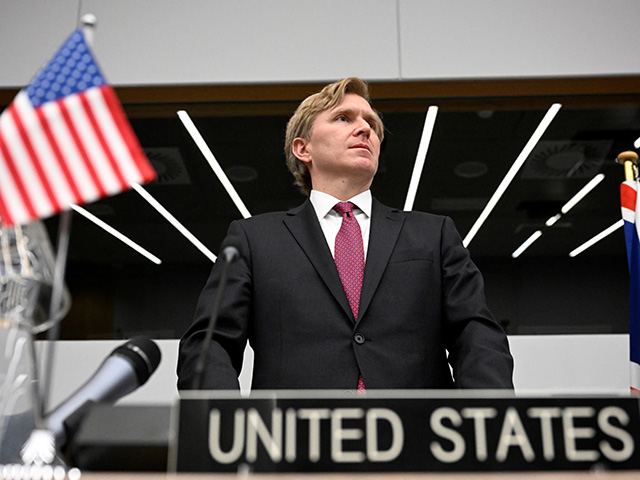
The report on Wednesday came from NBC News, which cited "five people familiar with the plans." According to these sources, Under Secretary of War for Policy Elbridge Colby is driving the shift toward tactical weapons. Colby is scheduled to present his ideas during a visit to U.S. Strategic Command (STRATCOM) headquarters in Nebraska on Wednesday.
U.S. Under Secretary of War for Policy Elbridge Colby looks on as he arrives with others to address the media during a defense ministers meeting at NATO Headquarters in Brussels on February 12, 2026. (JOHN THYS / AFP via Getty Images)
According to the report, Colby's contention is that America's potential nuclear adversaries already understand the capabilities of the U.S. "nuclear triad" — strategic bombers, submarine-launched nuclear missiles, and intercontinental ballistic missiles (ICBMs) — and have factored the deterrence value of long-range nuclear exchanges into their war plans.
Colby is allegedly concerned that Russia and China might come to believe that America would hesitate to escalate a conflict to such apocalyptic extremes if an adversary deployed small battlefield tactical nuclear weapons. Such a scenario has been suggested as a possible Russian response to impending defeat in Ukraine, for example, or China using tactical nuclear weapons if an invasion of Taiwan looked like a catastrophic failure.
The revised U.S. nuclear strategy would reportedly give the president options to respond in kind to tactical nuclear deployment by adversaries, instead of escalating to massive exchanges designed to eliminate the adversary's nuclear arsenal — and, potentially, a sizable portion of the human race.
Under this theory, Russia or China might calculate that the U.S. is unwilling to unleash nuclear Armageddon in response to a small warhead detonation, but if they knew the U.S. had realistic options for a more limited nuclear response, they might be more reluctant to take the gamble.
Conversely, critics of the approach reportedly presented by Colby worry that developing a tactical response would make America even more reluctant to use its strategic option. In this analysis, only the looming specter of apocalyptic nuclear war has prevented aggressor states from rolling the dice on a tactical deployment. A frustrated Russian President Vladimir Putin might conclude that wrecking Ukraine with tactical nuclear warheads is worth the risk of America hitting Russia with a few small bombs in return.
WATCH — Trump: I Thought Russia/Ukraine Would be Easy to Settle but Zelensky & Putin Hate Each Other:
A senior defense official told NBC that America needs tactical nuclear weapons that would "expand the president's option space by providing him with realistic and credible options and therefore strengthen deterrence."
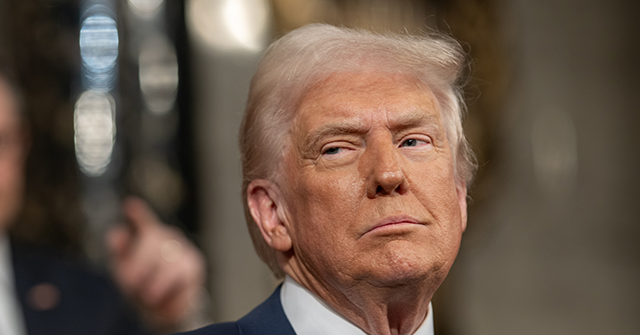
A source in Congress told NBC News that Colby's reported plan could shift resources away from the nuclear triad into theater nuclear weapons. Unless the U.S. begins building more warheads, it would be necessary to reassign the nuclear bombs in the current inventory. This would seemingly be contrary to President Donald Trump's pledge to "make our nuclear deterrence system great again."
President Trump's 2025 National Defense Strategy (NDS) called for a "strong, secure, and effective nuclear arsenal adapted to the nation's overall and defense strategies."
"We will modernize and adapt our nuclear forces accordingly with focused attention on deterrence and escalation management amidst the changing global nuclear landscape," the NDS said.
In February, Under Secretary of State for Arms Control Thomas DiNanno called for "a new nuclear architecture that addresses the threats of today, not those of a bygone era."
"This means taking into account all Russian nuclear weapons, both novel and existing strategic systems, and addressing the breakout growth of Chinese nuclear weapons stockpiles," he said.
"The United States will maintain a robust, credible, and modernized nuclear deterrent to ensure our security preserves peace and stability and negotiate from a position of strength. In doing so, we will prevent anyone from being able to dominate us or our allies so that all nations recognize their interests are best served through peace and restraint," he said.
DiNanno's remarks illustrated the problem of carrying the Cold War model of "mutually assured destruction" into a modern age when the U.S. is not wholly preoccupied with checkmating a single rival nuclear power. North Korea is also a threat and might be inclined to think it could get away with a limited tactical nuclear deployment, if the U.S. believes its only response option is all-out intercontinental nuclear war. Iran's nuclear program is obviously a major near-future concern.
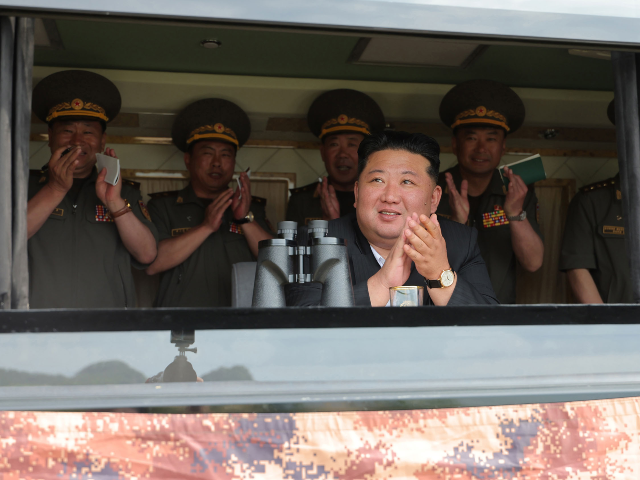
In this photo provided by the North Korean government, its leader Kim Jong Un, center, observes the weapon tests at an undisclosed location, North Korea, Thursday, June 25, 2026. (Korean Central News Agency/Korea News Service via AP)
An increased focus on tactical nuclear weapons could give the U.S. more options for providing limited nuclear capability to allies in Eastern Europe but of course this, in turn, could make Russia even more paranoid about the possibility of American nukes appearing on its borders.
Colby said during his confirmation hearing in March 2025 that he supported the nuclear triad, although he acknowledged "concerns about the health of the program," particularly development of the LGM-35A Sentinel land-based ICBM, which was intended to replace the aging Minuteman III missile.
Colby wrote an article for Foreign Affairs in 2018 in which he anticipated the danger of Russia, China, or their satellites attacking U.S. allies and using the old Cold War logic to "block any efforts by the United States to fight back."
"This should cause great alarm among U.S. policymakers: American grand strategy is rooted in a network of alliances designed to maintain favorable regional balances of power and protect U.S. access and trade across the globe. These alliances work as long as they can be credibly defended against outside challengers," he noted.
Colby said the U.S. needed to "demonstrate to Moscow and Beijing that any attempt to use force against U.S. friends and allies would likely fail and would certainly result in costs and risks well out of proportion to whatever they might gain."
"This requires conventional military power, but it also means having the right strategy and weapons to fight a limited nuclear war and come out on top," he wrote eight years ago, perhaps presaging the classified strategy he presented at STRATCOM on Wednesday.
Source link