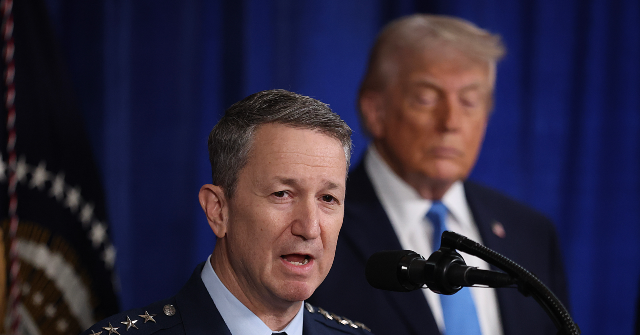
As President Donald Trump considers whether and how to conduct military strikes against Iran ahead of another round of talks in Geneva, Joint Chiefs Chairman Gen. Dan Caine has advised the president and senior officials that such action could carry significant risks, including the possibility of a prolonged conflict, according to Axios.
Axios reported that Gen. Caine has advised Trump and top members of his national security team that a military campaign against Iran could carry serious consequences, including the possibility of the United States becoming entangled in a prolonged conflict. The account was based on conversations with five sources who either attended or were briefed on high-level internal meetings.
According to Axios, Caine has not advocated for a strike but would execute any decision the president ultimately makes. One source described him as a “reluctant warrior” in discussions about Iran, contrasting his posture with his support for the operation to capture Venezuelan leader Nicolás Maduro. While Caine was described as fully supportive of the Venezuela operation, two sources told Axios he has been more cautious regarding Iran because he views the stakes as higher and the risks of entanglement and American casualties as greater.
Another source with direct knowledge of Caine’s thinking told Axios that the chairman is not opposed to a military campaign but is “clear-eyed and realistic” about the likelihood of success and what could unfold once a conflict begins. A senior official pushed back on suggestions that Caine had voiced skepticism.
Joint Staff spokesman Joe Holstead told Axios that, in his advisory capacity, the chairman presents “a range of military options” along with “secondary considerations and associated impacts and risks,” and does so confidentially. White House spokeswoman Anna Kelly remarked in a written statement that Caine is a “talented and highly-valued” member of Trump’s national security team and that the president hears “a host of opinions” before deciding what he believes best protects U.S. national security.
Axios wrote that Gen. Caine has recently been “the only military leader” providing briefings to President Trump on the Iran crisis. The outlet further noted that U.S. Central Command chief Adm. Brad Cooper was not included in the Iran-focused meetings Trump has convened and has not spoken with the president since the standoff began in early January. A senior administration official confirmed to Axios that Trump has not had contact with Cooper during that period. By contrast, Cooper’s predecessor, Gen. Erik Kurilla, had previously briefed both Trump and former President Joe Biden on Iran matters, according to the report.
The article outlined active internal discussions among senior officials over how to manage the confrontation with Iran and what the potential fallout of each available course of action might be. Several advisers have been pressing for restraint, though one individual familiar with the deliberations stated the president has been inclined toward approving military action in recent days. A separate source indicated that Trump pushed for continued diplomatic engagement by his envoys in order to ensure all options are “exhausted” before making a final determination. According to those briefed on the meetings, none of the participants has supported an invasion or “boots on the ground” operation.
At 3:11 p.m. on Monday, President Trump posted on Truth Social:
Numerous stories from the Fake News Media have been circulating stating that General Daniel Caine, sometimes referred to as Razin, is against us going to War with Iran. The story does not attribute this vast wealth of knowledge to anyone, and is 100% incorrect. General Caine, like all of us, would like not to see War but, if a decision is made on going against Iran at a Military level, it is his opinion that it will be something easily won. He knows Iran well in that he was in charge of Midnight Hammer, the attack on the Iranian Nuclear Development. It is a Development no longer, but rather, was blown to smithereens by our Great B-2 Bombers. Razin Caine is a Great Fighter, and represents the Most Powerful Military anywhere in the World. He has not spoken of not doing Iran, or even the fake limited strikes that I have been reading about, he only knows one thing, how to WIN and, if he is told to do so, he will be leading the pack. Everything that has been written about a potential War with Iran has been written incorrectly, and purposefully so. I am the one that makes the decision, I would rather have a Deal than not but, if we don’t make a Deal, it will be a very bad day for that Country and, very sadly, its people, because they are great and wonderful, and something like this should never have happened to them.
Vice President J.D. Vance has been expressing concern during internal discussions about the possibility that military action could draw the United States into a deeper conflict. A source told Axios that Vance has been raising questions about the risks and operational complexity involved, while another described his role as laying out arguments “on both sides” to ensure the president can make an informed choice. The same source emphasized that Vance is not “outright opposed” to a strike.
Secretary of State Marco Rubio, meanwhile, has been characterized by two sources as “sitting on the fence” rather than pushing firmly for or against military action. Although Rubio has long been viewed as hawkish on Iran, Axios said that he has recently devoted more attention to issues involving Venezuela and Cuba.
Trump’s envoys Steve Witkoff and Jared Kushner are scheduled to meet Iranian Foreign Minister Abbas Araghchi in Geneva on Thursday for another round of indirect negotiations facilitated by Oman. According to Axios, both men have counseled the president to delay military action for now, arguing that additional diplomatic engagement could improve Washington’s leverage before any final decision is made.
In a Fox News interview over the weekend, Witkoff explained that Trump has been “frustrated” and “curious” that Tehran has not “capitulated” under mounting U.S. military pressure, though he added that those characterizations may overstate the president’s posture. Witkoff also cautioned that Iran could be “a week away” from refining its highly enriched uranium into “industrial-grade bomb-making material,” warning that such a development would significantly narrow the window for diplomacy.
Outside the administration, Sen. Lindsey Graham (R-SC) has emerged as a leading voice in Trump’s broader orbit pushing for military action. In comments to Axios on Saturday, Graham expressed he was frustrated that several of the president’s advisers were urging restraint and discouraging strikes against Iran. He also pressed Trump directly during a Sunday phone call to proceed with military action rather than delay.
Israeli Prime Minister Benjamin Netanyahu is likewise advocating for strikes. According to Axios, Netanyahu has become increasingly concerned since meeting with Trump roughly ten days ago that the United States might ultimately decide against military action. A U.S. source who met with Netanyahu last week told the outlet that the prime minister left his meeting with Trump feeling he had not succeeded in moving the president toward his position. “Is he still with us?” Netanyahu asked, the source said.
A senior administration official told Axios, “Everyone has a job to do and does their job. Rubio isn’t figuring out what planes to fly. Caine isn’t worrying about diplomatic fallout. The decision to strike, when and how or if at all, has not been made.”