
On July 16, 1988, Florence Griffith-Joyner sprinted 100 meters in 10.49 seconds at the U.S. Olympic Trials in Indianapolis. Nearly four decades later, no woman has run faster, and her world record still stands.
Her 200-meter record, set at the Seoul Olympics later that year, has also stood for almost forty years.
Flo-Jo remains the fastest woman who has ever lived.
Yet her 100-meter record has repeatedly been surpassed by American high school boys.
The current U.S. high school boys' record is 9.92 seconds, set in 2025 and more than half a second faster. Many boys have run faster than Flo-Jo's legendary mark, and each year more join that list.
At the 2026 California state track championships, seven of the eight finalists in the boys' varsity 100 meters ran faster than the women's world record.
If any of those athletes had identified as female and been permitted to compete in the women's division, Florence Griffith-Joyner's forty-year-old world record would no longer stand.
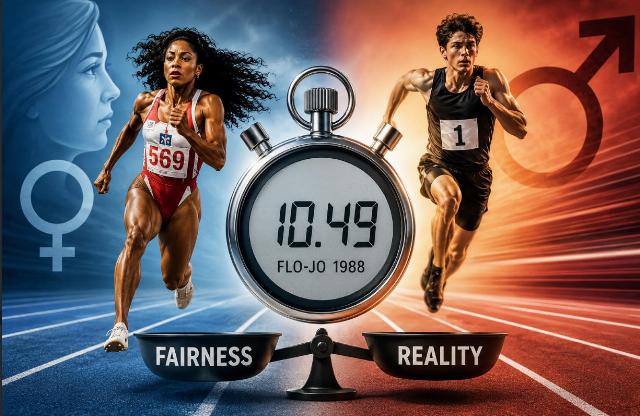
Image created by ChatGPT
The same pattern appears across sports.
The women's long jump world record is 7.52 meters, set by Soviet athlete Galina Chistyakova in 1988. The U.S. high school boys' record is 8.18 meters — more than half a meter farther.
Democrats will not recover from this. pic.twitter.com/FhfHpd1dKx
— Bo French (@bofrench) August 4, 2026
These are not Olympic champions.
They are high school and college athletes.
Women's world records mark the outer limits of female athletic performance. Yet many high school boys surpass those limits before they are old enough to vote. That is precisely why women's sports exist.
The point is not that boys are "better" athletes than women. The point is that men and women are biologically different, and elite female athletes compete in a separate category precisely because of those differences.
Without sex-based competition, women's sports would disappear.
For years, activists argued that testosterone suppression erased male athletic advantages. The science has not supported that claim.
The International Olympic Committee now acknowledges that athletes who have undergone male puberty retain significant advantages in strength, power, endurance, and body mechanics even after testosterone suppression.
That conclusion should surprise no one familiar with human physiology.
Puberty fundamentally changes the male body. Males typically develop greater muscle mass, denser bones, larger hearts and lungs, higher hemoglobin levels, broader shoulders, longer limbs relative to height, and greater explosive power. Those structural changes persist after hormone therapy.
Once the athletic engine has been built, lowering testosterone later in life does not rebuild the chassis.
That is why nearly every measurable athletic event — from sprinting to jumping, swimming, cycling, rowing, and weightlifting — exhibits a substantial performance gap between elite men and elite women.
Changing language cannot change biology.
Physicians use different names for diseases all the time. A heart attack is also called a myocardial infarction, and a stroke may be termed a cerebrovascular accident. The terminology changes, but the underlying biology does not.
Likewise, calling a biological male a woman does not change chromosomes, skeletal structure, muscle physiology, or athletic performance.
The overwhelming majority of people are born either XX or XY, with biological sex established at conception. Rare disorders of sexual development exist, but they do not erase the fundamental biological distinctions that have always underpinned sex-based athletic competition.
This debate has become unnecessarily complicated because many people confuse equal dignity with identical biology.
Every person deserves respect and should be treated compassionately.
But compassion does not require abandoning objective reality or biology.
No one argues that weight classes in boxing are discriminatory because heavier athletes have natural physical advantages. Age divisions in youth sports acknowledge developmental differences. The Paralympics exist because physical impairments affect athletic performance.
Women's sports were created for the same reason: biological differences matter.
Recognizing those differences is not discriminatory.
It is the foundation of fair competition.
That reality appears to be gaining broader acceptance.
The International Olympic Committee has now adopted a policy limiting eligibility for the women's category at Olympic events to biological females, verified by a one-time SRY gene screening. The IOC concluded that athletes who have undergone male puberty retain significant athletic advantages and that protecting the female category requires a biological rather than an identity-based standard.
A growing number of international sports federations have adopted similar standards, not out of prejudice but because the scientific evidence has become increasingly difficult to ignore.
For several years, many institutions insisted that biology was secondary to gender identity. Athletes who questioned the fairness of competing against biological males were often portrayed as intolerant rather than simply asking for the level playing field that women's sports were designed to provide.
Today, the evidence proves those concerns were well founded.
Athletes are now taking notice and speaking up. WNBA star Sophie Cunningham said that "biological men" should not compete in women's sports, adding that her stance is "kind of common sense."
Number 1-ranked female tennis player in the world, Aryna Sabalenka, finishes press conference by saying men shouldn't be in women's sports.
— Collin Rugg (@CollinRugg) August 4, 2026
"It's obvious that biologically the men are way stronger than women."
Crazy that the ‘trust the science’ crowd finds this controversial. pic.twitter.com/7PsGREMLut
A French transgender basketball player who looks like an NFL linebacker "wouldn't turn down an offer to play in the WNBA." Let's see how that plays out.
Even better, days ago, two former NBA players, Enes Kanter Freedom and Royce White, announced plans to enter the 2027 WNBA draft because the league's current eligibility rules do not define who qualifies as a "woman."
Kanter had the money quote, "If simply declaring who you are is all that's required, then I meet every single requirement necessary to compete in the WNBA."
Good luck to the WNBA in untying the Gordian knot they crafted.
Strength and power are not discriminatory.
The stopwatch has no ideology.
Neither does the measuring tape.
The scoreboard has no political affiliation.
Objective performance is indifferent to slogans, social movements, or wishful thinking.
Nearly forty years after Florence Griffith-Joyner electrified the track in Seoul, her extraordinary achievements still define the limits of women's athletic performance. They deserve to remain the accomplishments of the fastest woman in history — not to be erased by redefining who qualifies as a woman.
Language can be rewritten. Biology cannot. And the stopwatch never learned political correctness.
Brian C. Joondeph, M.D., is a Colorado-based ophthalmologist who writes frequently about medicine, science, and public policy.
Follow Brian:
Twitter @retinaldoctor
Substack Dr. Brian's Substack
Truth Social @BrianJoondeph
LinkedIn @Brian Joondeph
Email [email protected]
Source link