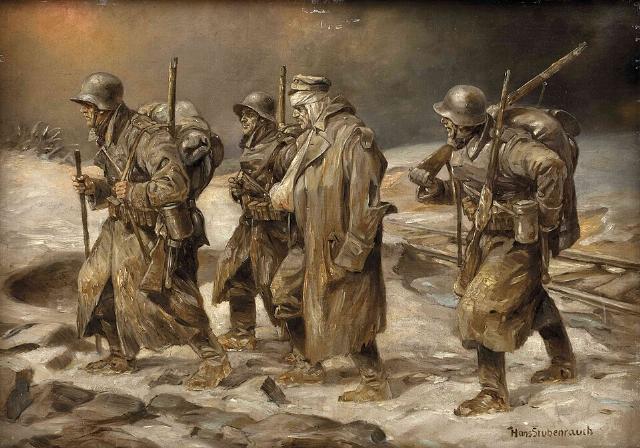
From Wikimedia Commons: German Soldiers in World War I (Hans Stubenrauch, 1915)
In the blood-soaked arena of the twentieth century, where ideologies of total domination masqueraded as movements of popular renewal, an ideological chasm yawned between the true conservative—guardian of inherited law, hierarchical order, and moral continuity—and the barbarian revolutionary, whether Bolshevik or Nazi. While the former trusted in institutions tempered by tradition, honor, and transcendent duty, the latter dissolved them into a cult of power, where the Führer or the Party became the sole arbiter of existence. Revolutionary justice invariably translated into the arbitrary sword of the tyrant, dispensing violence and death as instruments of omnipotent will.
A person who embodies this clash with tragic heroism is Claus Schenk Graf von Stauffenberg, the aristocratic soldier who, having once glimpsed national revival in Hitler’s rise, recoiled from its descent into nihilistic tyranny and struck against it on July 20, 1944. His self-sacrificing act, rooted in the conservative soul’s revulsion at lawlessness, stands in stark contrast to the insights and laments of fellow anti-Nazi conservative thinkers: Edgar Julius Jung, Oswald Spengler, and Ernst Jünger. Together, they illuminate a pessimistic truth: in an age of mass vulgarity and ideological frenzy, the conservative’s defense of order is often a noble but doomed rearguard action.
In popular culture (e.g., the Hollywood film Valkyrie from 2008), Stauffenberg is largely portrayed as a democratic freedom fighter. However, this transfer of modern motives is historically unjustified. To be sure, Stauffenberg was no liberal democrat, no apostle of Weimar’s parliamentary chaos. Instead, he was a conservative nationalist, forged in the crucible of traditional military values, Swabian aristocratic heritage, and devout Catholicism. Initially, like many officers of his class, he welcomed the 1933 National Socialist seizure of power as a deliverance from the Versailles humiliation and Weimar’s decadent liberalism. The rebuilding of the Wehrmacht, the assertion of German sovereignty—these aligned with a patriotic realism that prioritized strength and regeneration over egalitarian pieties. Yet his deeper allegiances lay elsewhere.
Profoundly shaped by the George Circle (Georgekreis) and the mystical poet Stefan George, Stauffenberg imbibed a vision of Geheimes Deutschland—a “Secret Germany” of spiritual aristocracy, aesthetic elitism, and inner nobility. In opposition to plebeian nationalism, this was a hierarchical, almost Platonic ideal: rule by an elite of cultivated souls, guardians of high culture against the encroaching vulgarity of the masses.
George’s influence instilled in Stauffenberg a visceral rejection of Nazi Gleichschaltung—the crude leveling, the aesthetic barbarism of brown-shirted rallies, the anti-Christian persecutions, and the cult of the Führer as a demagogic idol. Where the Nazi barbarian saw law as an immediate extension of the Leader’s will—arbitrary, terroristic, unbound by precedent or ethics—the conservative saw law as the embodiment of organic order, personal honor, and moral responsibility.
Stauffenberg’s cultural elitism clashed fundamentally with the regime’s egalitarian mobilization. The Night of the Long Knives (1934), which saw the liquidation of ideological rivals in a revolutionary orgy of self-purification—evoking the Saturn metaphor of Jacques Mallet du Pan—stripped away any remaining pretense of conservative restraint. Thus, Stauffenberg’s moral awakening accelerated with the regime’s escalating state terror, the perversion of the military ethos into blind obedience to atrocity, and the desecration of Christian foundations.
As the war grimly progressed, particularly after he witnessed the realities of the Eastern Front and the machinery of the Holocaust, of which disturbing reports had reached him, Stauffenberg’s duty crystallized: tyrannicide as the ultimate act of conservative fidelity. Notably, he never intended to usher in liberal democracy; his purpose was to salvage a regenerated German Reich rooted in tradition.
Stauffenberg’s personal evolution marks him as a man of action, a soldier-hero in the classical mold. Unlike the purely intellectual conservatives, he bridged thought and deed. His July 20 Plot, Operation Valkyrie, went far beyond an individual assassination in scope: it represented a coordinated attempt to restore martial law, purge the party clique, and establish a post-totalitarian order preserving national strength while rejecting barbarism. He pragmatically collaborated across factions, including with socialists, yet remained a nationalist envisioning imperial regeneration rather than capitulation to Western models. His last words—“Es lebe das heilige Deutschland!” or invocations of the Secret Germany—encapsulate this: a mystical-conservative patriotism against the “prince of vermin” spreading his pestilent realm, as in George’s prophetic verse.
Comparing Stauffenberg’s moral activism to the purely intellectual resistance to barbarism provided by Edgar Julius Jung—the intellectual spearhead of the Conservative Revolution—gives food for thought. Jung, a leader of the anti-Weimar, anti-liberal right, articulated a vision of organic, elite rule against both Marxist chaos and Nazi plebeianism. His 1932 writings and the 1934 Marburg Speech (delivered by Franz von Papen) lambasted Nazi violence and propaganda, calling for a return to Christian foundations and fraternal order over fanatical agitation.
Like Stauffenberg, Jung despised the “rule by the inferior” of mass democracy and saw National Socialism as a destructive but potentially preparatory force—yet ultimately a betrayal. Murdered by the Gestapo in the Night of the Long Knives, Jung’s fate underscores the barbarian’s intolerance for any conservative counter-voice. Where Stauffenberg acted with the sword, Jung wielded the pen in defense of the same hierarchical ethos. Both rejected the Nazi conflation of order with total domination; both paid with their lives.
Oswald Spengler, the monumental chronicler of civilizational decline in The Decline of the West (1918–1923), offered a colder, more pessimistic mirror. Initially sympathetic to the idea of “national renewal,” Spengler grew disillusioned, critiquing in Years of Decision (1933) the Nazi movement’s demagogic excesses, its failure to embody true Prussian Caesarism, and its concessions to mass politics. He envisioned an aristocratic, soldierly order—Prussian socialism in service to high culture—against the “clodhoppers” and “square heads” of egalitarian frenzy.
Spengler’s Caesarism demanded a commanding elite unbound by ideology yet rooted in tradition; Hitler’s regime, in his view, risked becoming another symptom of decline, a barbaric parody rather than fulfillment. Stauffenberg’s elitism echoes Spengler’s, but the soldier translated metaphysical pessimism into ethical action, refusing passive observation. Both saw the barbarian’s arbitrary violence as accelerating, not arresting, Western decay.
Finally, Ernst Jünger, the WWI storm-trooper, was an intellectual comrade-in-arms of Stauffenberg, sharing his soldierly ethos. The early glorification of war’s primal energies by the former fed conservative-revolutionary currents, but he resolutely distanced himself from pompous Nazi self-staging and vulgarity. His On the Marble Cliffs (1939) allegorized the regime as demonic ruffians crushing civilized order. An aesthetic aristocrat, he maintained inner emigration, scorning the plebeian terror while associating with plotters.
Unlike Stauffenberg, who chose a decisive strike, Jünger preferred detached observation, letting the system consume itself. Both shared frontline experience and contempt for Nazi lawlessness—Jünger’s “Kniebolo” for Hitler mirroring Stauffenberg’s moral revulsion—but the elder writer’s stoic pessimism contrasts the younger’s activist heroism. Jünger survived; Stauffenberg died affirming the eternal Reich. (Kniebolo was a secret pseudonym used to refer to Hitler in private war journals and allegorical works, merging ideas related to the devil or kneeling to evil.)
The July 20 conspirators, including Stauffenberg, differed from politicians like Carl Friedrich Goerdeler, the designated Reichskanzler in the shadow cabinet, in their post-Hitler visions—Stauffenberg’s pragmatic nationalism and elite collaboration versus more monarchist or administrative restorations—but united in rejecting totalitarian arbitrariness. Their failure, beyond tactical lapses, was symptomatic of a deeper civilizational pessimism. The conservative’s trust in law and order, tempered by nobility and duty, confronted the barbarian’s will to power, which weaponized modernity’s masses, technology, and ideology into unprecedented domination.
Interestingly, the plot’s collapse and the regime’s apocalyptic finale vindicate Spengler’s Decline: barbarism triumphs temporarily because the old elites, though heroic, are outnumbered by the vulgar tide. Stauffenberg’s bomb was a flash of conservative lightning in gathering darkness—a passionate, if quixotic, assertion that true order demands ethical limits, even unto death.
The epic clash between civilization and barbarism resonates with foreboding. Ideological barbarians persist, cloaked in new rhetorics of “equity” or “security,” eroding law into tools of domination. Stauffenberg and his peers remind us that conservatism is not “reaction” but the passionate defense of the humane hierarchy against the abyss. Their pessimism was earned; their nobility, eternal. At a time when society rekindles its romance with absolute ideologies, dismissing their cautionary shadows invites our own undoing.