
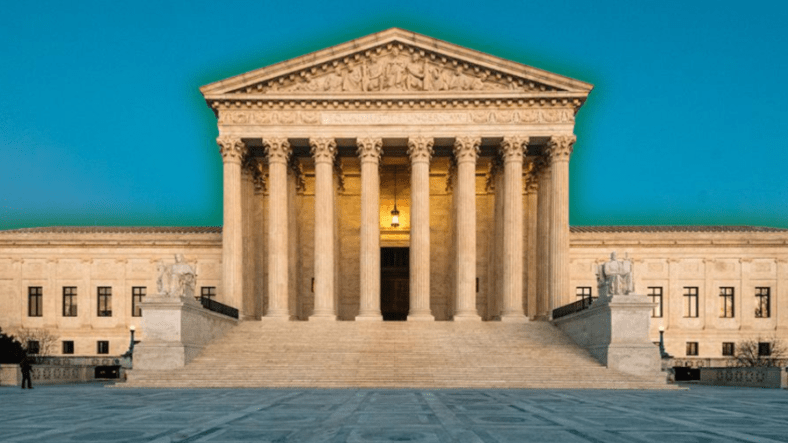
The United States Supreme Court has ruled 6-3 against President Donald Trump (R) in a long-awaited decision concerning the tariffs he imposed on numerous countries last year.
Dissenting from this ruling were Justices Clarence Thomas, Brett Kavanaugh, and Samuel Alito. Justices Neil Gorsuch and Amy coney Barrett each issued concurring opinions.
According to the majority of the Court, the federal law upon which President Trump relied to enact these policies does not permit the president to impose tariffs.
Authored by Chief Justice John Roberts, the opinion explains that the Trump Administration’s view of the law would “would represent a transformative expansion of the President’s authority over tariff policy.”
“The Framers did not vest any part of the taxing power in the Executive Branch,” wrote Chief Justice Roberts.
It was not addressed by the Court whether or not companies may get refunded for the tariffs they have already paid.
“The Court says nothing today about whether, and if so how, the Government should go about returning the billions of dollars that it has collected from importers,” Justice Kavanaugh noted in his dissenting opinion. “But that process is likely to be a ‘mess,’ as was acknowledged at oral argument.”
The Associated Press reports that more than $133 billion worth of tariffs have been collected by the Treasury Department, as shown by federal data.
[RELATED: Supreme Court to Consider Legality and Constitutionality of President Trump’s Tariffs]
The cases that prompted this ruling from the Court first arose in response to President’s Trump decision to impose tariffs on a wide variety of goods entering the country from many places around the world via a series of executive orders this past spring.
Known as the International Emergency Economic Powers Act, or IEEPA, the 1977 law at the heart of this case gives the president broad authority to regulate economic transactions under a declared emergency.
Despite having been invoked by prior presidents, IEEPA has never before been used by the chief executive to impose tariffs. Historically, presidents have used their authority under IEEPA to impose sanctions on enemies or freeze assets.
President Trump called upon the authority granted in IEEPA to presidents during times of emergency to “regulate…importation” of “property in which any foreign country or a national thereof has any interest,” arguing that it permitted him to impose tariffs without going through Congress.
Trump’s novel usage of the federal provision prompted many to challenge the resulting tariffs in court, paving the way for the Supreme Court to issue an official interpretation of the authority granted by the IEEPA and the constitutionality of these implications.
“The fact that no President has ever found such power in IEEPA is strong evidence that it does not exist,” the Chief Justice said of this novelty in the Court’s ruling Friday.
At issue in this case were two categories of tariffs imposed by the President: “trafficking tariffs” and “reciprocal tariffs.”
While trafficking tariffs focused specifically on goods from Canada, China, and, Mexico — countries that the President believes have not done enough to stem the flow of fentanyl into the country — reciprocal tariffs were imposed upon a wide range of nations, starting at a rate of at least 10 percent.