Republicans' failure to embrace artificial intelligence safety could cost them dearly during the midterm elections and beyond, according to a poll exclusively obtained by the Daily Caller News Foundation.
A Guidant Polling and Strategy survey issued a dire warning for Republicans in 21 swing districts who fail to champion AI safety issues favored by a supermajority of voters. It stated that voters trust Democrats more than Republicans on AI regulation — and they would be much more likely to vote for a congressional candidate that supports stronger policies on the issue.
Republicans could have an even more uphill battle after the midterms should Democrats "own" AI safety, the polling memo dated Oct. 29 explained.
"Common-sense AI guardrails are among the rare issues that unite voters across party lines, and battleground voters are clear that they will reward candidates who support them," the polling memo obtained by the DCNF stated.
"Right now, Democrats have the early edge on trust largely because Republicans have been quiet, not because voters have rejected the GOP's approach," the memo continued.
Battleground voters trust Democrats over Republicans to handle regulating AI by a seven-point margin — or 43 to 36 percent — with 21 percent saying they trust neither party or remain unsure, according to the poll. Independent voters trust Democrats by a 37 to 26 percent margin, while 37 percent have not picked a side. (RELATED: The Issue Making Politicians Sweat As November Midterms Loom)
The survey found 80 percent of voters would be more likely to back a congressional candidate that backed "common-sense" regulations, including 49 percent who would be much more likely to vote for that candidate.
More than two-thirds of Republicans, Democrats and independent voters would be more likely to vote for candidate that backs AI guardrails, per the poll.
GPS National AI Battleground Memo by tyler
In contrast, opposing regulations on AI would harm a candidate's chances, with 66 percent of voters saying they would be less likely to back a candidate who opposes AI guardrails, the poll found.
Many of these congressional districts polled by Guidant will likely decide if Republicans maintain their House majority during the midterm elections.
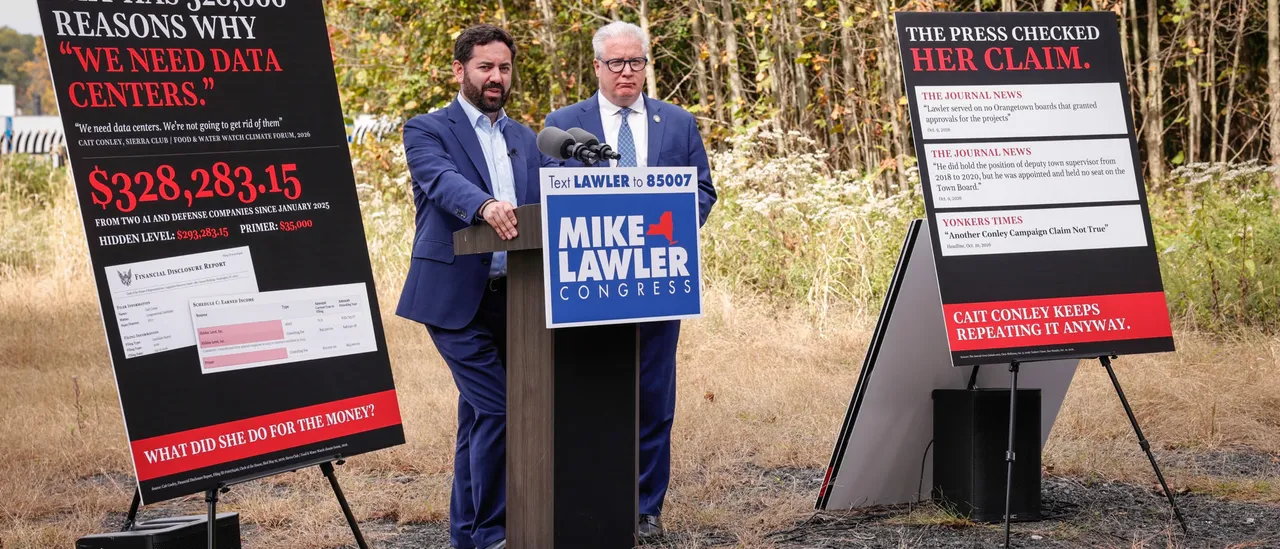
This includes New York's 17th District, represented by New York Republican Rep. Mike Lawler, where AI safety remains a focal point in the key swing district race.
Lawler flipped his seat during the 2022 midterm elections, defeating a five-term Democratic incumbent. The New York Republican, alongside New Jersey Democratic Rep. Josh Gottheimer, introduced AI safety legislation in September, including the Stop Rogue AI Act, a bill that would require the National Institute of Standards and Technology (NIST) to develop national standards to rein in renegade AI agents. The legislation has stalled in committee.
AI poses a very real threat to the safety and security of the American people, and it’s long past time that Congress took action to regulate it. But Mike Lawler is standing in the way, because he’s looking out for his trillionaire backer Elon Musk.
— Cait Conley (@CaitforNewYork) October 15, 2026
Last year, Mike Lawler voted… pic.twitter.com/bkczJwX0Z1
Lawler leads Conley by three percent per an Oct. 2 internal McLaughlin & Associates poll, while Conley leads Lawler by two in an Emerson College poll released Oct. 1. The nonpartisan Cook Political Report rates the race between the two candidates as a "toss up."
AI poses a very real threat to the safety and security of the American people, and it's long past time that Congress took action to regulate it. But Mike Lawler is standing in the way, because he's looking out for his trillionaire backer Elon Musk. Last year, Mike Lawler voted to ban states from regulating AI for 10 years. We cannot afford to wait a decade to enact guardrails that should already be put in place. We need members of Congress who actually understand how to regulate AI and ensure it doesn't pose a threat to our national security. After serving at the Cybersecurity and Infrastructure Security Agency, that's the exact expertise I will bring to Washington.
— Cait Conley (@CaitforNewYork) October 15, 2026
"Last year, Mike Lawler voted to ban states from regulating AI for 10 years. We cannot afford to wait a decade to enact guardrails that should already be put in place," Conley wrote in her post.
"Mike has worked across the aisle on common-sense AI guardrails. He led on the CHAT Act to protect kids from AI companion chatbots, introduced the Stop Rogue AI Act with Democrat Josh Gottheimer, and voted for the TAKE IT DOWN Act, which cracked down on AI deepfakes and is now law. Hudson Valley parents want AI that's safe for their kids, and that's the record he's running on. Cait Conley was paid $328,283.15 by two AI surveillance contractors, Hidden Level and Primer, and still won't say what she does for the money," Ciro Riccardi, Lawler's campaign manager, told the DCNF in a statement.
Conley's campaign did not immediately respond to a DCNF comment request.
Voters back child and AI safety issues as well as national security regulations on AI, according to the Guidant poll.
It found that more than 84 percent of voters back stronger parental controls on AI, requirements to disclose that chatbots are AI, stipulations that minors cannot have relationships with minors, regulations against non-consensual deepfakes, banning election-related fake posts and banning chatbot self-harm instructions.
The Power Behind American AI | With @CJohnsonAELI and @MarkBednar pic.twitter.com/qxZhhjHANa
— Daily Caller (@DailyCaller) September 17, 2026
More than 84 percent of voters also back regulations to stop unauthorized AI hacking, rules for monitoring AI capabilities and behavior, government safety testing of AI before the model is released, granting the government the power to shut down AI-related threats and establishing third-party evaluators to test for AI safety, per the poll.
Eighteen percent of voters say Republicans do not talk enough about AI guardrails, 26% are not sure what they believe and 20% oppose AI regulation.
"Championing guardrails would not cost Republicans with their base, and our voters see it as a winning issue," Guidant's memo stated.
Republicans want "reasonable guardrails over fewer regulations by a nearly 2-to-1" ratio, or 60 to 32 percent — and 60 percent want AI development to proceed with more safety in mind," the polling memo explained. Republicans backing AI safety measures would help a candidate by a 68 to 9 percent margin and independents agree by a 75 to 4 percent margin.
Americans dislike AI and data centers but voters rank the economy as their top issue heading into the midterms as Americans grapple with a wide affordability issue with higher gas prices due to the wars in Iran and Ukraine, the DCNF reported in early October.
In some races, the data center and AI regulation may become more salient, as the biggest issues in Ohio include the economy, tariffs and data centers, the Daily Caller reported in October.
The risks of not backing AI extend beyond the midterm election cycle, the polling memo warned.
"If Democrats own this issue next cycle, Republicans will be fighting uphill with an electorate in which two-thirds of voters (66%) say they would turn away from a candidate who opposes guardrails," the memo stated.
"Republicans who speak clearly and early on protecting children, securing selections, and keeping AI out of the hands of foreign adversaries can claim this issue; those who stay silent risk ceding it to Democrats heading into 2028," the polling memo concluded.
The Guidant Polling & Strategy survey contacted 1,000 likely 2026 general election voters across 21 "toss up" congressional districts. Half of the interviews were conducted online, with the remainder split between texts to web and phone interviews. The poll has a margin of error of plus or minus 3.1 percentage points.
Source link