Australians have been handed another interest rate rise, and another reason to question whether their government understands the role that it can play to help avoid further rate rises to address rising inflation.
The Reserve Bank's decision to lift the cash rate by another 25 basis points to 4.85 per cent, the fifth increase this year, squeezes household budgets already battered by expensive groceries, power bills and petrol.
For businesses, higher financing costs arrive at the same time as customers have less to spend, a double whammy.
A government elected promising relief is instead presiding over a renewed tightening of the financial screws.
If the Opposition were remotely united with ready-to-go frontbench talent, it's hard not to think that Labor would be in political trouble.
Higher interest rates are a necessary evil when inflation remains stubbornly above target.
Allowing price pressures to become entrenched imposes its own punishment, particularly on those least able to protect themselves.
That is why critics of the RBA are out of their economic depth.
Yet necessity doesn't soften the blow of this latest rate rise: higher repayments forces households to cut spending, investment to stall and hiring to slow down.
Because rate changes work with a lag, the cumulative damage risks overshooting the mark. My sense is that the RBA is less worried about bringing on a recession than it is about the long term consequences of entrenched high inflation.
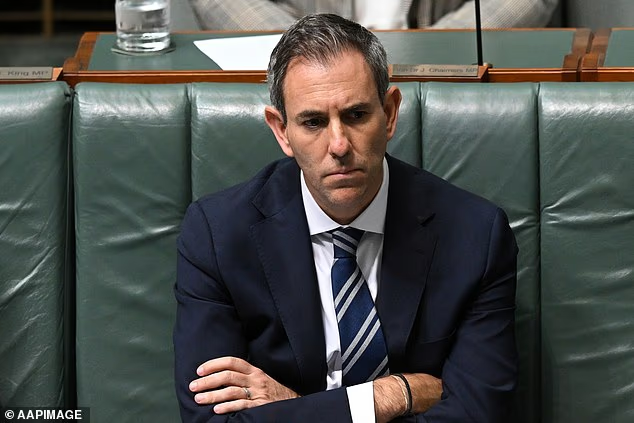
In January last year, Jim Chalmers declared the worst of the inflation challenge 'well and truly behind us'
Anthony Albanese recently called interest rates a 'blunt instrument'. He's right, but the observation raises an obvious question: what is he doing with the more targeted instruments at his disposal? The government is in charge of fiscal policy which isn't a blunt instrument.
The RBA can't rewrite the federal budget. It can't trim Commonwealth programs, defer infrastructure projects or shelve spending commitments that have grown too expensive to justify.
The government can do all of that.
The political difficulty is that ministers must put their names to the choices made. Leaving the adjustment to the RBA via the blunt instrument of monetary policy (raising rates) allows the government to stand beside struggling borrowers, lamenting their predicament and quietly egging on criticism of the RBA Governor doing what she has to do, chiefly because the government won't play its part in the fight against inflation.
The governor delivers the bad news; the politicians deliver the sympathy.
Jim Chalmers' explanation for falling house prices earlier today was more buck passing. The Treasurer pointed to higher borrowing costs as the driver of the property downturn, which is undeniably true, but only to an extent.
The government has also altered the tax treatment of property investments, via a broken election promise as it so happens.
Restricting negative gearing and trimming capital gains tax concessions inevitably changes investor returns, dampening demand for established housing, an outcome that was part of the policy's design in fact.
The Commonwealth Bank estimated the changes would leave prices roughly three per cent lower than they otherwise would have been. While that doesn't reveal the exact split between monetary and fiscal drivers, it confirms that interest rates are an incomplete alibi.
The real test is whether the government properly judged the combined impact when it drafted the policy.
Lower prices offer limited comfort to prospective buyers when borrowing capacity is shrinking and repayments are rising.
For recent buyers, especially those who entered the market with thin deposits, the outcome is especially brutal: more expensive servicing of debt secured against an asset shrinking in value.
Labor eagerly claimed credit when inflation softened. In January last year, Chalmers declared the worst of the challenge 'well and truly behind us'.
It was akin to George W Bush declaring victory during the Iraq war, years before it finally ended.
Bullock, in contrast, repeatedly warned that bringing inflation sustainably under control would take time.
That history makes it much harder to cast the central bank as the villain today.
While Canberra can't control overseas supply shocks or dictate world oil prices, it does control the budget choices that can ease or amplify the burden.
Source link