Jack Clark is an unlikely tech bro: his alma mater, the University of East Anglia (not an Ivy League campus), his degree in English literature (not computer science, mathematics or physics). And he's British (not American).
Outside Silicon Valley – and the nerdy world of computers – no one has really ever heard of him, certainly not on this side of the pond anyway.
Yet, at 38, Clark has quietly joined possibly the most consequential group of individuals on the planet and is about to become one of the richest.
Some people who pass him in the street might mistake him for Meta co-founder Mark Zuckerberg, with whom he has more than a passing resemblance.
But he is, in fact, one of the seven co-founders of Anthropic, the AI giant behind chatbot Claude, which is about to be listed on the stock market with a prospective valuation of at least $1.5trillion (£1.1trillion) – that's 1,500,000,000,000 or one-and-a-half million million – by the way.
What this will mean for Clark, born and bred in Brighton where his father still lives, is beyond the dreams of most people.
He already has a net worth of $13.7billion (£10.2billion) on paper, according to Forbes magazine, and he can expect to bank considerably more than that if the flotation of Anthropic goes the way analysts predict.
How far has he come? Very far, it would seem. At the start of his career, he was living in a 'very dingy apartment' (his description) and earning £19,000 a year as a humble tech hack.
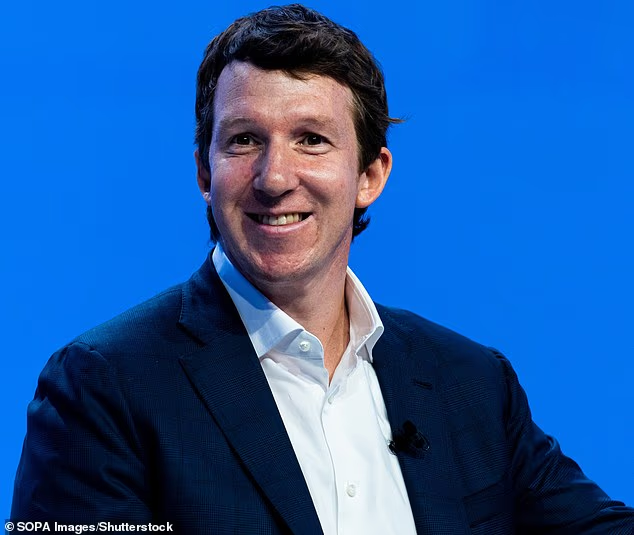
British-born Anthropic tycoon Jack Clark is an unlikely tech bro after earning a degree in English Literature at his alma mater, the University of East Anglia
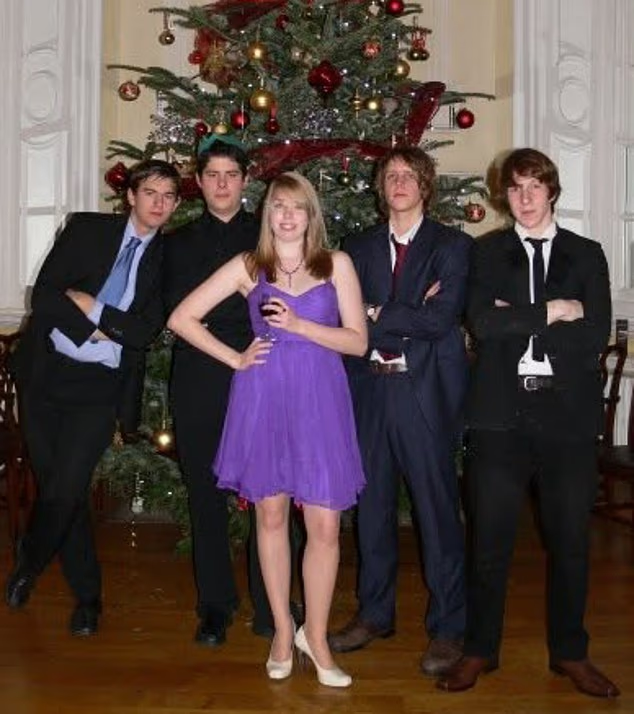
A floppy-haired Clark, far right, stands with fellow UEA students, including Emmeline Saunders
Today, he is one of the seven board members of Anthropic, the so-called 'gang of seven', under the leadership of chief executive Dario Amodei.
Between them, they hold 50.1 per cent of voting rights which, in the words of one business commentator, gives them 'a controlling vote over the direction of the company – and, potentially, humanity'.
The AI revolution, Anthropic says, could lead to Nobel Prize-winning breakthroughs in medical research, potentially curing Alzheimer's and cancer, but has also warned of a 10 per cent chance it could kill us all within the next decade. Comprehensive school-educated Clark is therefore at the centre of what many believe is the most important and contentious debate of our age.
He now holds dual British-American citizenship and lives in San Francisco with his wife Olivia, 37, who was once an amateur MMA (Mixed Martial Arts) fighter, and their two young daughters.
Yet there is still a big part of him that is forever England, as revealed in the Doctor Who nights he regularly, and proudly, hosts and posts about at his home.
As he revealed on X, his 'CharcWHOterie' parties (so called because platters of meats are laid on for guests) have been going on for some time – and are likely to continue.
'Watching all of Doctor Who, both modern and old series – lasted five years so far,' he revealed.
He and a friend are also 'trying to perfect the english (sic) sausage roll – been doing it a year, people bring chips and dip and hang out while we make them.' You will not be surprised to learn that AI plays an important part in Clark's family life – even in his relationship with his father Peter, whom he jokingly describes as a 'grumpy guy from South Shields'.
'Go see your dad', the chatbot Claude once told Jack when he sought 'his' advice on an unspecified topic.
'That was the correct answer,' Clark acknowledged in a recent interview.
His upbringing in the leafy suburbs of Brighton couldn't have been more unremarkable.
He attended the local state school, Varndean. His mother, a nurse, died when he and his younger brother, who also works in tech, were teenagers.
It is clear that the boys inherited their tech genes from their father Peter, a semi-retired financial and technical copywriter, now in his 70s, and an expert in cryptocurrencies. Speaking this week on the doorstep of the family home where Jack grew up, Peter was more than happy to take a modicum of credit for his son's enormous success.
'I think Jack is a bit like me,' he told the Daily Mail. 'People think I'm crackers because I'm always telling them about things that will happen in the near future.
'He is the same, right? Of course, he has a lot more insight than me, but he is also absolutely convinced the world will be unrecognisable in two or three years and he is trying to steer it in a way that it will not be hellish.
'Unfortunately I don't get to see him as much as I'd like because he's 6,000 miles away and he's extremely busy, but when I do see him we get on really well.'
Jack's educational path did not follow an obvious route: while he excelled in science at school, he only got D grades in English but nevertheless decided to study English and Creative Writing at university, in Norwich. This, explained Mr Clark senior, was due to the influence of a very inspirational teacher at Varndean, who'd sparked his interest in writing. And his eldest son clearly knew his own mind, says Peter.
'Jack had a huge social life when he was a teenager, but like all teenagers he could also be a bit "arsey",' he added wryly.
He clearly made an impression at UEA, however. Fellow student Emmeline Saunders worked alongside him on the student newspaper Concrete, a name derived from UEA's brutalist 1960s architecture, during their time there.
The pair go back a long way: she is the young woman in the mauve cocktail dress in the photograph of the editorial team at a Christmas party in 2007.
The floppy-haired young man on the right is Jack Clark. 'Jack was always incredibly clever,' Ms Saunders, now a national newspaper journalist, told us. 'Whatever room he was in, he would be the smartest one there.
'But he was lovely with it. He didn't tend to speak much.
'He had a self-assurance about him – quietly confident – that is quite rare.
'Even back then he was talking about technology that would help humans to share knowledge.
'Who could ever foresee anyone becoming a billionaire? But Jack doesn't fit the mould of a "tech bro" in any way, which I think is for the best.'
The pair's paths crossed again at the same content marketing agency, Adfero, in London's Canary Wharf – Jack's first job after graduating in 2009.
On his LinkedIn CV, he says that as a researcher and reporter he 'covered technology, finance and environmental issues and became interested in data centres'. He was tasked with writing basic 'SEO-friendly' (search engine optimisation) articles to help promote the agency's clients online.
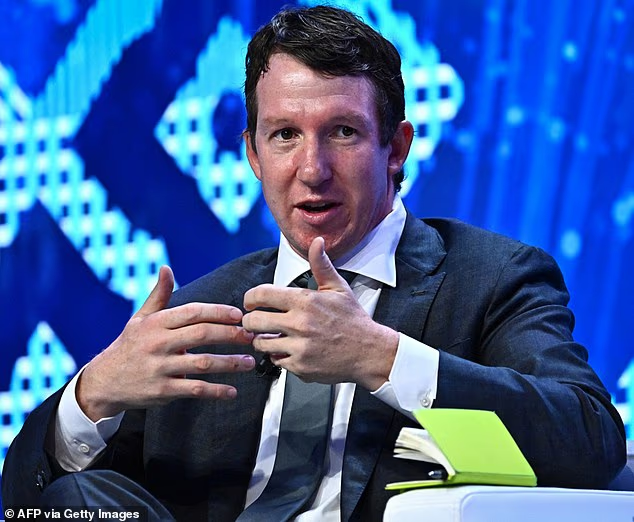
Jack's upbringing in the leafy suburbs of Brighton couldn't have been more unremarkable – but he clearly inherited his tech genes from his father Peter, a financial and technical copywriter
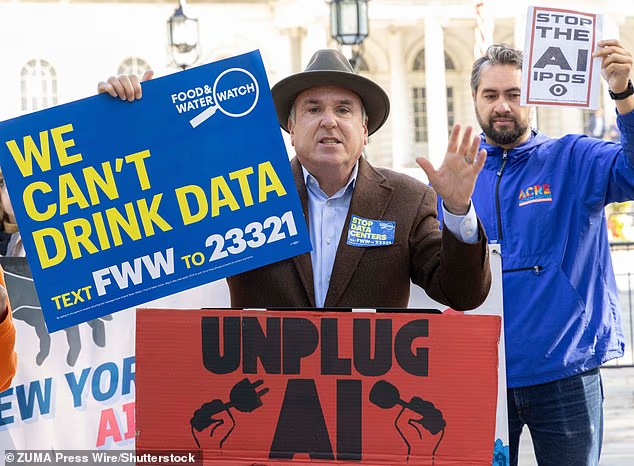
Campaigners from Food & Water Watch hold anti-AI signs as they protest in New York ahead of a hearing on the dangers of AI with representatives from Anthropic, OpenAI, Google and Meta
'It was an awful job, to be honest,' said Ms Saunders. 'Jack and I would go out for drinks together and be moaning about how little we were paid and how overworked we were. I don't think we ever discussed where he was living but most of us were living in pretty s**t flat shares.'
At least his next job at a technology website offered travel. Only someone like Jack, however, would have found it appealing.
It involved touring and reviewing his beloved data centres, monolithic, windowless boxes 'around Europe and the rest of the world'.
He called the series the 'Clark side of the Cloud', a kind of Hitchhikers Guide to the Galaxy (without the fun or excitement), you might say, for computer nerds.
In 2013, he landed in San Francisco and eventually got a job with Bloomberg, a global leader in business and financial information. He was part of Bloomberg's Big Tech team covering Google and AI and doing very well.
His editor was Alistair Barr. When contacted by the Daily Mail, Mr Barr pointed to an article he had written about him last year.
'Jack walked up to me in the San Francisco newsroom and asked if we could go for a walk,' he recalled. 'As an editor, it's often not good when one of your reporters makes a request like this. Sure enough, as we sat looking over the bay, Jack told me he was quitting to join a non-profit called OpenAI. I said it was a terrible idea. OpenAI was less than a year old at the time and was still a relatively obscure research group.
'Its major claim to fame was Elon Musk's [uneven] financial support. I selfishly also wanted Jack to stay at Bloomberg. I pressed my case. Jack had a pretty stable job. In contrast, OpenAI didn't seem to have much of a direction and I couldn't see a path for it to become financially sustainable beyond asking Musk for more money. I thought I was pretty persuasive but Jack ignored me and left.'
The headline of the article read: 'An employee told me he was quitting to join OpenAI in 2016. I said it was a bad idea. Now he's an AI billionaire.'
OpenAI, under Sam Altman, is the company behind ChatGPT, which went from zero to one million users, making it one of the fastest growing apps in history.
And Jack Clark was there when history was being made, first working in strategy and communications, then as policy director.
'He was in the right place at the right time,' his father said, and not just because OpenAI was turning science fiction into science fact.
The vice president of research was Dario Amodei who had met Jack at a conference some years earlier.
Amodei was the man who famously led the walkout from OpenAI at a virtual meeting in December 2020 when he suddenly announced that six key figures were quitting over safety concerns. 'Emoji, exclamation points and shocked messages flooded the meeting's chat window,' The Atlantic magazine revealed in an investigation last month. One of the messages was from Jack Clark: 'I love you all,' it said.
'Then, suddenly, their screens went dark,' The Atlantic reported. 'OpenAI had removed them [the rebels] from the call, revoked their email and Slack access and remotely bricked their laptops.'
The following month Anthropic was founded. The name derives from the Greek anthropos (human), which is meant to convey the message that human wellbeing is fundamental to the company's ethos, which must abide by a set of strict ethical principles to prevent the Doomsday scenario.
But a British employee of Anthropic, Jacob Coxon, made headlines when he quit last month, accusing the company and OpenAI of 'gambling with our lives' with unchecked-AI and creating a 'superintelligence' that is leading to an impending apocalypse. The fear is very real: Clark was asked the following poignant question during a recent podcast interview: 'What do you think will be the life expectancy of your child, accidents aside?
He replied: 'I feel like 130 to 150... unless Claude kills us all.'
He's now devoted to ensuring this doesn't happen.
In March, he moved to a new role as Anthropic's head of public benefit. One of the first things he did was start the Anthropic Institute, an internal think-tank, to 'confront the most significant challenges about how powerful AI will impact the world around us.'
One person is very reassured knowing her old friend is at the helm. 'Everyone's scared of AI and the warnings we get from Silicon Valley that we're all going to die by its hand,' says Emmeline Saunders. 'But what I will say is that if the future of AI is in people like Jack's hands, I don't think we need to worry.'
- Additional reporting: Tim Stewart
Source link