In a May 28, 2026, essay for American Thinker, I predicted (over the ferocious protests of many Trump loyalists in the comments) that our blunder into Iran would become "Trump's Waterloo." Sadly for Mr.
Trump and our nation, that prediction came true in the recent midterm elections. I have never been more disappointed to be right.
There are only two ways to win a war. The first is not to fight. The second is to fight relentlessly to the bitter end. Having missed the opportunity to do the former, in Iran, Mr. Trump balked at doing the latter. The aura of power that surrounds the American president suddenly devolved into a pantomime of craven pleading for a "deal" to ensure the survival of the very lunatics we had just threatened with certain death. At no point did anyone, least of all the mullahs, believe that any such "deal" would be worth the paper it was written on. By three weeks in, virtually everyone (very likely including Mr. Trump) wished that we had never gotten into this mess, but everyone equally understood that finishing what we started would require the complete annihilation of the Iranian regime. And yet, to the great detriment of his own reputation and the reputation of others who sought to defend him, Mr. Trump assured an increasingly incredulous public that the negotiations with the mullahs were meaningful and that we were "winning."
Mr. Trump, in fact, declared that he was on the cusp of achieving "peace for our time" with the Iranians so frequently and so sincerely, it would have made Neville Chamberlain blush. We were told there was a deal on Monday only to learn there was no deal on Tuesday. We were told the Straits of Hormuz were open on Wednesday only to find them closed on Thursday. Then on Friday, Mr. Trump would assure us once again that we had the Iranians exactly where we wanted them. And so it went, week after week, with all the usual talking heads on conservative media, wishing more to be loyal than honest, assuring us it would all be over "in another two to three weeks, tops."
Well, Mr. Bonaparte, things did not go according to plan.
What, then, is my point? Am I here to gloat? Certainly not. Do I keep quarter with people like former president George W. Bush and his neocon pals, who now actively root for the depraved left and the defeat of the America First agenda? Absolutely not. But George W. Bush has an important lesson to teach us for the present moment in American politics.
At the time of the ninth Republican presidential primary debate on February 13, 2016, there was no sacred cow of Republican Party orthodoxy holier than the necessity and probity of President George W. Bush's 2003 decision to invade Iraq. So far beyond the pale of acceptable discourse was this question that, incredibly, nobody on the team of Republican frontrunner Jeb Bush's presidential campaign had prepared him to answer it. And yet, nothing was more obvious to the American people than that this decision had been a colossal mistake. Donald Trump was no disloyal Republican, but he was the only candidate unafraid to say what every other candidate privately knew to be true: that the decision to invade Iraq on the pretense of stopping a non-existent weapon of mass destruction had been, in the words of George F. Will, "the worst foreign policy blunder in American history."
When the American people saw that Donald Trump was willing to tell them the truth, even when it was embarrassing to people who were revered in his own party, they made him the 45th president. The 48th president, whoever he may be, faces a similar challenge. He must decide whether to circle the wagons and defend Mr. Trump's decision to go to war in Iran, as many of us did before the midterm elections with disastrous results, or, like Mr. Trump himself in 2016, speak the hard truth, admit this mistake, and assure the American people it will not happen again.
What is the hard truth about the war in Iran? That Donald Trump, high on his own supply in the wake of the spectacular success of the Maduro raid, and riffing unsupervised on his phone at 3 a.m. on January 3, 2026, wrote a check with his fingers that his generals could not cash. The check was a promise that "[I]f Iran shoots and violently kills peaceful protesters . . . the United States of America will come to their rescue. We are locked and loaded and ready to go."
Anyone watching Mr. Trump in the days after he made that unprecedented threat, which Iran blithely ignored, could see the internal conflict on his face. Iran was taunting him, Trump was dithering, the people he promised to protect were being murdered by the tens of thousands, and America had no plan or feasible means to do anything about it. What happened next? Well, the nuclear program we were assured had been "obliterated" during Operation Midnight Hammer, six months earlier, and about which we had heard exactly nothing before Mr. Trump's 3 a.m. tweet, magically came roaring back to life. Like the monster in a cheesy horror movie, just when we thought it was dead, Iran's nuclear program was not only still alive but supposedly "a week away" from pulling a fully functional atomic bomb from the rubble. Presto-change-o, Trump's mission impossible to save the Iranian people became a much more feasible aerial bombing campaign to "make sure Iran will never have a nuclear weapon."
Yes, it really was that sophomoric. And yes, we have been here before.
As revealed in General Colin Powell's 2012 memoir, It Worked for Me, the CIA knew that President George W. Bush was itching to go after Saddam Hussein to avenge his father. So, they told him that a source, whose code name, tellingly, was "Curveball," had confirmed that Saddam was using vans as mobile production labs for biological weapons. Curveball, who had not been vetted and whom even the Europeans knew not to trust, had confirmed no such thing. America went to war needlessly, thousands of young soldiers lost their lives, many thousands more were horribly maimed, the entire region was destabilized, and America squandered two trillion dollars it could ill afford to waste. And yet for two presidential election cycles after Bush left office, pride, stubbornness, and sunk-cost fallacy kept virtually all leading national Republicans from admitting this spectacular betrayal. Perhaps more than any other single factor, this explains why no one trusted them and elected an unknown upstart named Barack Obama for two terms, instead.
The 2028 Republican nomination, the presidency, and the mantle of leadership in the America First movement await the Republican who has the courage to say about President Trump's decision to attack Iran what candidate Trump said about President George W. Bush in 2016. Now is the time for candor, not pride. Trump was wrong to try to topple the Iranian regime.
Michael Hurley is an author and a retired attorney. 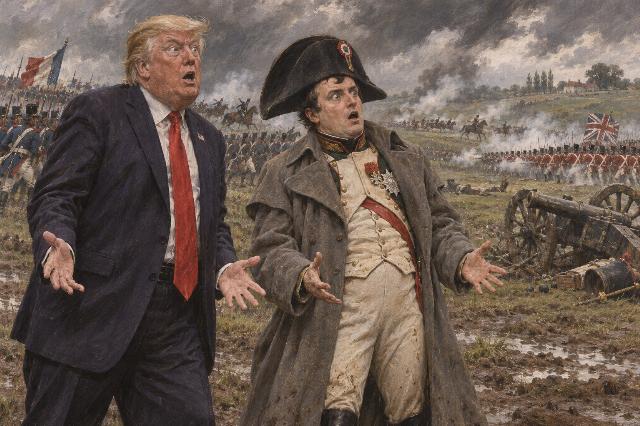 Image generated by ChatGPT.
Source link