Summary
- Trump Delays Iran Decision: Trump says he is in no rush to resume strikes, favoring more time for diplomacy despite Netanyahu's reported push for renewed military action.
- Ayatollah Signals Openness to Talks: Supreme Leader authorizes dialogue with Washington as Qatari mediation reportedly makes progress toward a draft agreement.
- Faster Hormuz Reopening on the Table: Iran says it could reopen the Strait within two days if Washington accepts its demands, including lifting the US blockade.
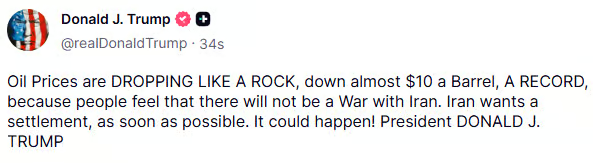
- Oil Prices Tumble: Hopes of a diplomatic breakthrough send Brent toward $106 and WTI below $100, triggering a broader risk-on market rally.
- Supply Risks Persist: Nearly 1 billion barrels have reportedly been drained from global inventories, leaving oil and diesel markets vulnerable to renewed escalation.
Trump Says 'No Rush' on Renewing Iran War
On midterm election eve, President Trump is seeking to appear confident and is trying to reassure voters. He told Axios in a phone interview published Monday afternoon that he's "in no rush" to decide whether to resume attacks on Iran.
There's lately been an avalanche of speculation saying that he's likely to order a new bombing campaign soon after the midterm vote on Tuesday. There are also reports saying that Israel's Netanyhu is strongly lobbying for renewing the war. Of course, Trump knows the war is deeply unpopular with the average voter (on both sides of the aisle) right now, and so the obvious attempts at 'calming' the populace...

Trump told Axios that "it's coming together nicely, that's why oil is down" - in reference to indirect negotiations being mediated by Qatar. He also indicated that Iran asked to stop killing its leaders, to which he responded, "we will" - in his accounting of recent messaging.
Iran's Supreme Leader Floats More US Talks In Rare Overture
Oil is tumbling in the wake of a somewhat rare headline out of Tehran:
- Iranian President Pezeshkian says the Supreme Leader has granted the government some authority on dialogue, ISNA reports
- OIL FALLS TO INTRADAY LOW, BRENT TRADES NEAR $106/BBL
- Oil prices down 6% on hopes of US-Iran diplomacy
This marks some of the most significant confirmation yet that the Supreme Leader - who has been in hiding and not seen in public since the assassination of his father upon the opening of Operation Epic Fury - is still 'open' to a negotiated solution to the war. It has long been speculated that he and the more 'hardline' IRGC and affiliated officials are against talks and are preparing for war.
Meanwhile, more Monday reporting of 'breakthroughs' via regional sources - and the possibility that Washington might give up on isisting the nuclear enrichment issue be resolved...
A breakthrough in US-Iranian negotiations was seen after Qatari mediation successfully overcame procedural obstacles, reports Al Jadeed citing a diplomatic source
- The US is leaning towards not making the nuclear issue a priority and instead including it within the overall negotiation framework.
- Washington's priority is achieving a breakthrough in the nuclear file, which Trump would present to the American people, in exchange for concessions on other issues in favor of Iran.
- There are fears that Netanyahu will succeed in undermining the breakthroughs in the US-Iranian negotiations and pushing the region towards escalation and war.
- Any US-Iranian agreement will inevitably have repercussions for Lebanon, while any war on Tehran would be fateful and would push Hezbollah to enter it.
- Implementing any agreement on Lebanon requires Israel's conditional approval, which is contingent upon Hezbollah's disarmament and the dismantling of its military apparatus; otherwise, Israel will launch a war to achieve its objectives.
Presdient Trump too has signaled he wants to give diplomacy more time, amid reports that Israel's Netanyahu is lobbying for more military action.
Newsquawk notes of the immediate reaction in markets: Risk-on trade seen as reports Iran's Pezeshkian said the Supreme Leader has granted the government some authority on dialogue got wider airing; downside in oil and the Dollar, with upside in US equity futures, Treasuries and spot gold.
Earlier in the morning a report in the NY Post included some of the details related to ongoing indirect dialogue:
- Earlier, sources said Iranian negotiators left the Doha talks on Sunday, but not due to difficulties in negotiations, with a draft proposal circulated for feedback and a follow-up meeting possible. Iranian Foreign Ministry spokesperson Baghaei also said the compression of Tehran's seven-day proposal into two days is a sign of goodwill and that "America must make a decision", which added modest pressure to the complex.
- It was also reported earlier today that Iran had reportedly conveyed seven conditions to Qatar for reaching an agreement with Washington, including lifting the US blockade of Iranian ports, according to Kyodo citing a senior Iranian official. Tehran is said to be willing to adopt a flexible position on nuclear issues if an agreement to reopen the Strait of Hormuz is reached, although significant differences remain as the US seeks simultaneous nuclear concessions.
Still, time is running out and Trump is threatening to "bring the hammer" on Iran; however, there's still no articulated end game or what a 'misson accomplished' moment might look like, amid fears that Washington could be settling in for another 'forever war' - despite 'assurances' from admin officials like JD Vance.
Still no 'direct' talks on the horizon:
Iran has no plans for talks with US officials, Foreign Minister Araghchi says, adding that Washington must accept Tehran’s conditions before a decision on direct or indirect negotiationshttps://t.co/tNvIQ4xV0f
— TRT World (@trtworld) October 31, 2026
Crude Prices Tumble
Brent crude futures fell to $108.41 a barrel, while WTI slipped below $100 this morning, after Axios reported that President Trump favored giving diplomacy with Tehran more time before launching another round of "Epic Fury." Separately, Iranian Foreign Ministry spokesman Esmaeil Baqaei said Tehran could reopen the Strait of Hormuz within two days if the Trump administration accepts its demands.
"Oil prices eased on Monday, with Brent down 2.8% at about $110/bbl and WTI down 3.3% at $100.67/bbl, as hopes for diplomatic progress tempered the geopolitical premium embedded in crude following October's rally. Iranian and Qatari officials have held three consecutive days of talks aimed at ending the conflict with the US and Israel," UBS markets analyst Nana Antiedu wrote in a brief note earlier today.
Brent's Friday gains have been erased ahead of the US session. There were other reports that Trump told Israeli Prime Minister Benjamin Netanyahu he wanted diplomacy with Iran. Secretary of State Marco Rubio said Saturday that no decision had been made on new attacks on Iran and that Trump preferred a diplomatic resolution.

Tehran: Shortened Timeline to Reopen Strait if Agreement Reached
Earlier today, Foreign Ministry spokesman Esmaeil Baqaei was quoted by Bloomberg as saying that Tehran was ready to reopen the Hormuz maritime chokepoint in two days if the Trump administration was willing to agree to its conditions.
"The possibility of implementing this plan in two days is another indication of Iran's good-faith approach," Baqaei said, adding, "We have stated that, if Iran's demands are met, it would be possible to restore security to the Strait of Hormuz and resume the negotiating process within a short period."
The spokesman said that an exchange of messages was ongoing with US counterparts via mediators and that "everything depends" on the US side accepting the Iranian demands. "Only then can we discuss the subsequent stages."
Despite the diplomatic signals, which can change at a moment's notice, UBS's Antiedu warned that global oil supply buffers are "wearing thin."
Antiedu added more color:
The pullback comes against an increasingly fragile supply backdrop. ADNOC CEO Sultan Al Jaber said nearly 1 billion barrels have been drained from global oil inventories since the conflict disrupted shipping through the Strait of Hormuz, Reuters reports. Diesel inventories in some markets are at 35-year seasonal lows, while shipping and logistics costs have risen from roughly 5% to 30% of the cost of a barrel.
Separately, June Goh, a senior oil-market analyst at Sparta Commodities, said that diesel is the "most distressed" fuel product heading into the Northern Hemisphere winter. She noted that spare refining capacity is mostly concentrated in China, where authorities continue to control fuel exports.
Goldman Sachs analysts earlier raised their Brent forecast to $105 a barrel for December and an average of $88 next year. They noted, "The Mideast and Russia-Ukraine conflicts, alongside broader geopolitical fragmentation, create high disruption risk."
Source link