At the conclusion of a dismal five-hour dash through incessant rain to London, James Shaw stood in silence as his son Michael's broken body lay before him. He had expected to see him in his St Bartholomew's Hospital bed, but death had come quickly – an hour before family members could reach him. Their goodbyes were now being said in the mortuary chapel.
A devout Catholic and a Lanarkshire miner all his adult days, the father was a man rooted in traditional beliefs. The son was homosexual, and now dead at 37 from Aids.
It made the scene which followed all the more striking. After a brief eulogy, as Michael's siblings were turning to leave, the father walked slowly towards his son, leaned forward and gently kissed him on his forehead.
It was, says Michael's older brother Peter, who was there that day 33 years ago, an act of 'unconditional love' which has been etched on his memory ever since.
In 2006, the art investor found his own way to express his love for the 'beautiful soul' lost to his family so tragically young.
It lay in a painting which he vowed to secure, even if it meant breaking the auction investor's cardinal rule: he entered a bidding war without setting himself an upper limit.
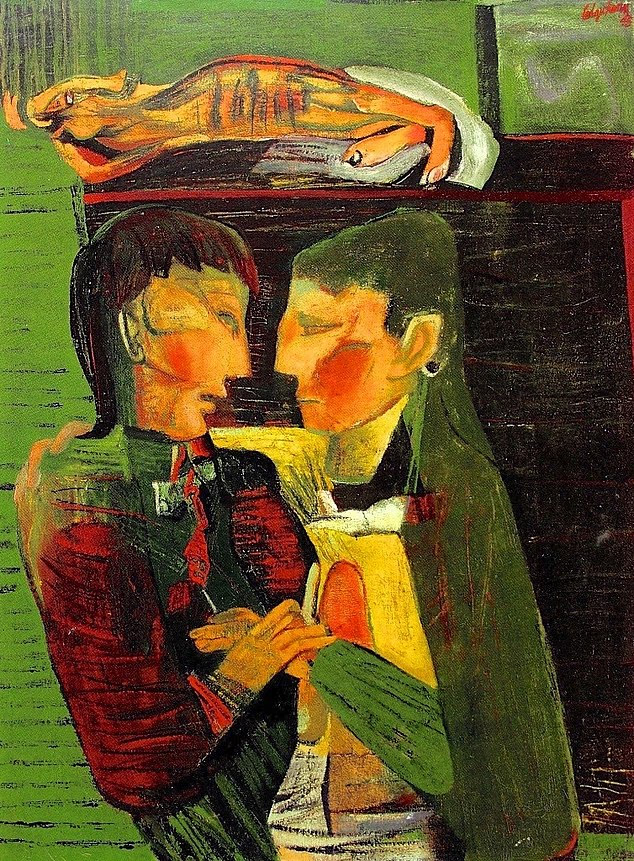
The estimate for Robert Colquhoun's 1945 canvas Actors on a Stage was £30,000 but that figure came and went in a heartbeat. It broke through £40,000 and, minutes later, £50,000 – and still the price climbed.
'There was no way I was losing it,' says Mr Shaw. Something about the painting spoke to him in a way no other artwork had done before, or could do again.
Actors on a Stage, by Robert Colquhoun, which is now in Peter Shaw's collection
The connoisseur in him recognised the piece as an example of European modernism by a significant Scottish artist at the peak of his powers. But the bereaved brother saw in its depiction of an emotionally intimate scene between two men a representation of Michael.
It seemed to embody who his sibling had been: a working-class gay man living in an age when acceptance was far from a given.
For Mr Shaw, its true value lay beyond art. The canvas was a sacred memorial for his brother – the most fitting tribute he could pay – and he had to have it.
The hammer finally came down at £60,000 – one of the highest prices ever paid for a Colquhoun artwork. Who knows how much more the collector may have paid if his rival bidder had not flinched?
Now, 20 years on, the painting is the most personally significant in a hoard of more than 12,000 treasures valued conservatively at more than £10million. Experts have described it as the finest private collection of Scottish artworks in the world.
Mr Shaw is now seeking to gift everything – including the Colquhoun – to the nation.
As the Mail revealed last month, he has hung none of his acquisitions on his own walls because he sees himself more as their guardian than their owner.
All he asks in return for the handover is a suitable public building within easy reach of working-class communities to display them.
Publicity-shy and reclusive throughout his decades-long quest to build the most comprehensive collection possible, the 72-year-old is now anxious for the story behind his most momentous purchase to be told.
'On a personal level, Actors on a Stage is by far the most important picture in my collection,' he says. 'For me, it is priceless – a wonderful, tangible memorial to a wonderful person.'
The realities of Michael Shaw's short life are ones his brother feels both Robert Colquhoun and his fellow artist and lover Robert MacBryde would instinctively recognise.
All three were gay men from the West of Scotland. All three moved to London to escape the culture of entrenched masculinity and overt prejudice prevalent in their part of the world.
Mr Shaw reveals Michael moved south in the mid-1970s after attempting to end his relationship with his Scottish boyfriend at the time. He was threatened with being exposed as gay unless they remained a couple.
'Michael had not come out at that point, and rather than cause his parents pain, he suddenly left for London, saying he had got a job at the Home Office,' says Mr Shaw.
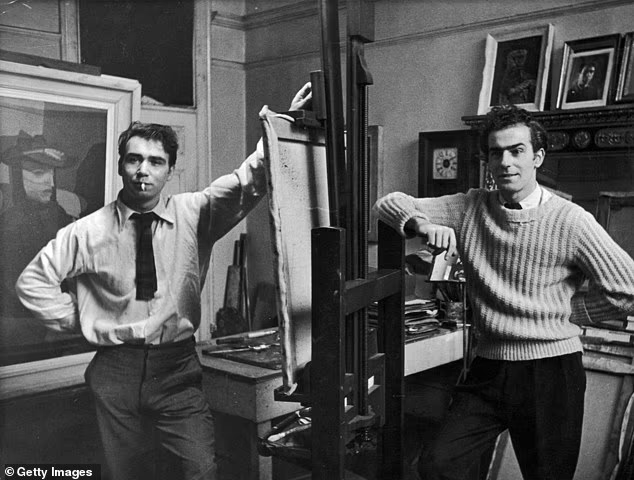
Scots Robert Colquhoun and Robert MacBryde
'It was only much later he told my sisters he was gay. Leaving home, not coming out, going through HIV and Aids until near death – all of it shows a man who thought first of his family rather than himself.
'The tragedy is that Michael's sexuality was not and never would be an issue for any of his family. We would have given much more support during his dark days had we known.'
Like the Two Roberts, as they came to be known, Michael had a bohemian streak and was passionate about many forms of art.
He was a talented actor in his youth and, at Glasgow University, studied classics. He was also an opera expert, regularly attending the Proms in London. Like his elder brother, his grounding in the visual arts began with the large print of Salvador Dali's Christ of St John of the Cross hanging in the living room of the Bellshill cottage where they grew up with their seven siblings.
His religious sensibilities never left him, even as he pursued a lifestyle he knew the church condemned.
It was 'typical of him,' says Mr Shaw, that he called his mother in his final days to offer comfort by telling her: 'I am reconciled to Mother Church.'
The strictures of his upbringing no doubt played their part in his decision not to reveal to his family that he had Aids. They found out only when he became too ill to hide it.
Mr Shaw says: 'Michael invited my sister Christine to his home in London and it was immediately obvious to her that he was seriously ill, and had no intention of telling her why.
'Ultimately, she confronted him directly by asking, "Do you have Aids?" Even then he was reluctant to acknowledge it but ultimately did.
'He must have lived with the condition for quite some time but, knowing Michael, he would have decided not to tell us so as not to cause his family concern. He would be dead less than three months after Christine's visit.'
For a time during his illness Michael returned to Scotland with his partner to stay with his parents. Traditional Catholics they may have been, but they allowed the couple to share a bed in their home.
That was why, months later, his father's final kiss to Michael's forehead came as no surprise to Mr Shaw. 'He was not judgmental; he didn't seek to impose his own beliefs on anyone.
'His love for family governed all his actions.'
And yet attitudes to homosexuality and Aids remained more entrenched and widespread in the early 1990s than many may care to remember. In 1987, Princess Diana attempted to dispel lingering myths by shaking an Aids patient's hand without wearing gloves.
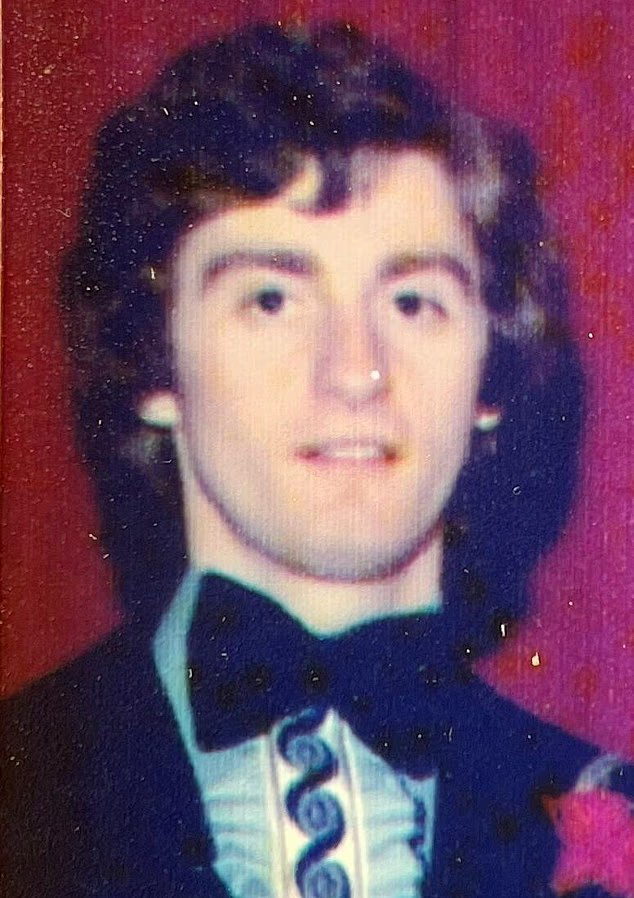
Peter Shaw's beloved brother Michael, who died aged 37 in the 1990s
Yet, six years later, many remained.
'The first undertaker I asked to arrange bringing Michael's body home refused when I said the cause of death was Aids-related,' says Mr Shaw.
'Eventually I found an undertaker who agreed, but only after charging thousands of pounds.
'I believe the undertaker knew how difficult it would be for me to find someone. I cannot remember the exact sum, but I remember thinking it bore no relation to a reasonable cost.'
Further difficulties arose over the vigil for Michael. His mother Christina was steeped in Irish Catholic burial traditions and wanted to pray over an open casket.
'Aids at the time required a closed casket and even that small comfort for families was taken away,' says Mr Shaw.
By the time of his brother's death, Mr Shaw was already aware of a seminal canvas by Robert Colquhoun portraying same-sex emotional intimacy – a theme almost unheard of in British art.
It had come up for auction at Sotheby's in 1988 when he could only dream of having the money to bid for it.
His circumstances changed dramatically in 1996 when, at the helm of Strathclyde Buses, he masterminded a sell-off deal which secured its workers tens of thousands of pounds and himself millions.
It was with this money that he began his collecting in earnest.
In 2006, when the painting next came up for sale, he studied it anew and realised there could be no more appropriate memorial for his brother.
It was a painting which seemed to hide the truth even as it lay in plain sight.
Mr Shaw says: 'Actors on a Stage would later be given the title of The Lovers, but that would have been unthinkable for Colquhoun. Instead, he adopted the long-standing subversion strategy of using theatre for plausible deniability. A stage setting provided a platform for hidden realities.
'The title and the theatrical cloak were a thin disguise for a portrait of the Two Roberts. Colquhoun was making a statement that could ruin his career, just at the point he was being acclaimed as one of the most exciting artists in Britain.'
He describes the painting as 'a reminder of the horrific persecution gay people faced until just 45 years ago' when homosexual acts were finally decriminalised in Scotland.
Like Michael, the Two Roberts each lived too brief lives. Colquhoun was 47 when he died in his lover's arms in 1962 after suffering a heart attack induced by alcoholism and overwork.
Devastated by his loss, MacBryde relocated to Ireland and was killed by a car in 1966 as he danced a drunken jig in the middle of a Dublin street. He was 53.
For Mr Shaw, echoes of his beloved brother abound throughout their story, and particularly in Colquhoun's depiction of a homosexual embrace.
'The painting relates to Michael in the same way it does for many gay men,' he says. 'It is emblematic of the truth seldom acknowledged in the period in which they both lived.
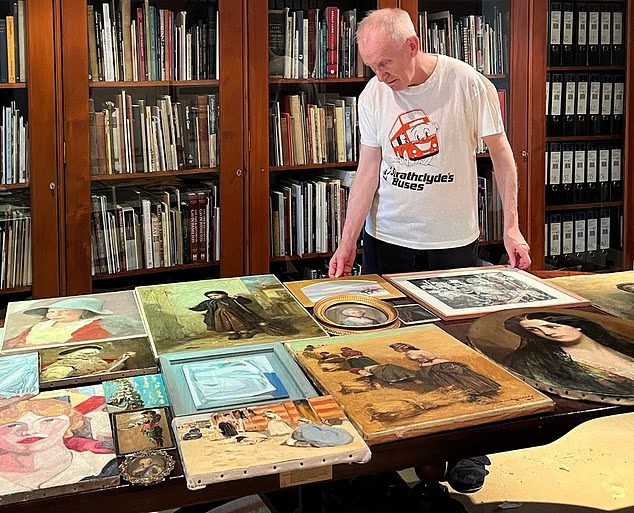
Peter Shaw examining a small selection of his collection of Scottish artworks
'All aspects of heterosexual love, gentleness, dignity and romance apply equally to gay love. The painting presents that quality that was often not possible to show.'
Largely forgotten by the time of their deaths, the Two Roberts' pioneering work has only come to be fully recognised as such in the present century.
'Their whole lives might be considered an art installation,' says Mr Shaw. 'Today they would have been perfect cannon fodder for the tabloids.'
A major exhibition of their work opened at the Dick Institute in Kilmarnock last month and will run until January 10. Its title seems to capture them perfectly – Robert MacBryde and Robert Colquhoun: Artists, Lovers, Outsiders.
As the art world remembers them, so the art collector, who owns work by them both, remembers his brother – an artist, lover and outsider too.
One day the painting he broke his own rules to secure will leave the shadows of private storage and pass into the custody of the nation.
Mr Shaw says he can't wait to give it away.
For only when it hangs in public will Actors on a Stage become what he always intended it to be: a living, permanent memorial to Michael Gerard Shaw.
Source link