Three years after she left the top job amid a growing scandal over the SNP's finances, Nicola Sturgeon is fast becoming the bad penny of Scottish politics.
She turned up on the BBC's Sunday with Laura Kuenssberg to give us the benefit of her unsolicited opinion on the current state of the nation.
Striking an unusual note of camaraderie, she said she wished the Prime Minister well, but then proceeded to berate him over his lack of a mandate and the dearth of detail on flagship plans such as social care reform.
This required not only a brass neck, but a profound detachment from reality.
Ms Sturgeon championed the abortive National Care Service – and plainly did not have a mandate to pursue the SNP's futile quest for Scottish independence.
Hypocrisy is nothing new from the former First Minister, but a period of reflective silence from her would not go amiss – let's say around 100 years.
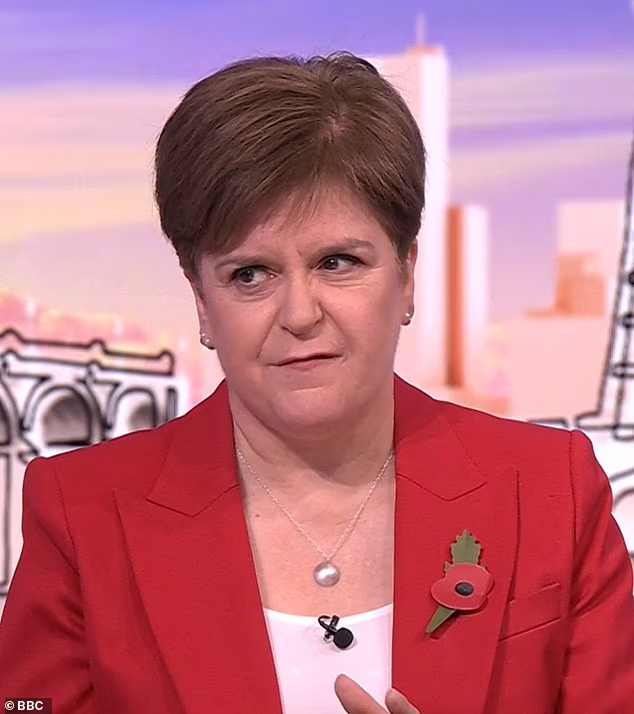
Nicola Sturgeon appeared on the BBC's Sunday with Laura Kuenssberg
On Sunday, she also chose to lecture others on economics and how the country should handle its finances.
This is a bit rich coming from someone whose estranged husband, Peter Murrell, was jailed for embezzling party funds.
We're all apparently supposed to forget about Murrellgate and write it off as though it were some dimly remembered Netflix drama.
But its shadow still looms large over Scottish politics – after all, there remains a great deal of unfinished business.
Murrell, the SNP's former chief executive, was jailed for more than five years after stealing £400,000 from party coffers.
Despite Ms Sturgeon's repeated assertions that she knew nothing about her husband's criminality, many Scots are unconvinced.
After all, Murrell purchased a luxury motorhome for more than £120,000 using money stolen from the SNP and parked it at his mother's property in Fife.
The suggestion that no one in the family noticed what was going on strains credulity.
At times, their orbit seemed less like that of a political power couple and more like the logistics operation of a small Amazon warehouse.
Murrell also received legal aid despite evidence of his considerable wealth.
He said he would repay the money he had stolen and yet somehow still qualified for state-funded assistance with his lawyers' fees.
Belatedly, the Scottish Legal Aid Board is said to be seeking to claw some of that cash back.
Whether it will be able to recover its reputation is a very different matter.
A Sunday Times poll at the weekend suggested 59 per cent of people do not believe Ms Sturgeon's claim that she knew nothing about her husband's extensive criminality.
In some ways, the only surprise is that the proportion is not significantly higher.
The former First Minister cannot be taken seriously again, either as a politician or as a commentator – her credibility is entirely bankrupt.
Indeed, even before Murrellgate that was a plausible argument. Now it is undeniable.
Ms Sturgeon's appearance on the BBC raises another question: why on earth is the Corporation still giving her airtime?
True, Ms Kuenssberg interviewed her after Murrell's conviction, with Ms Sturgeon's lawyer, Aamer Anwar, lurking in the background of the studio.
It was an instructive appearance, if only because it illustrated Ms Sturgeon's boundless capacity for self-delusion.
But it also suggested she had no intention whatsoever of making the dignified retreat from public life that many people would dearly like to see.
The BBC doubtless knew it would generate headlines by inviting her onto Ms Kuenssberg's Sunday programme.
But for many viewers it will have been a significant turn-off.
The truth is that Ms Sturgeon has become a figure of ridicule far beyond Scotland, though some in the liberal chattering classes continue to idolise her.
They probably see her predicament as nothing more than the product of a Right-wing smear or some elaborate conspiracy.
Around the time her husband was heading to prison, Ms Sturgeon was touring book festivals promoting an updated edition of her memoir, Frankly – a title that may yet go down as one of the great ironies of modern publishing.
It was a sickening display of narcissism, and one that neatly encapsulates why so many Scots have simply had enough.
Ms Sturgeon has also proved something of a back-seat driver from hell for John Swinney.
In a foreword to the latest edition of Frankly, she criticised the way he had fought the Holyrood election campaign.
The SNP emerged victorious but fell short of an overall majority, while its vote share declined.
Nonetheless, it was seen by many as an act of exceedingly bad grace by Ms Sturgeon to launch such a public attack on her successor.
Most former leaders understand that there comes a point where they should stop offering a running commentary and allow their successors to get on with the job.
Ms Sturgeon appeared to harbour a grudging respect for Margaret Thatcher and at one point even compared herself to the former Prime Minister – though one of her own most celebrated policies was the abolition of the Tories' totemic Right to Buy scheme.
When Baroness Thatcher was forced from office, she initially appeared determined not to make life difficult for her successor, Sir John Major, and largely kept her own counsel.
In time, however, she became a thorn in his side, particularly over Europe, a subject that went on to poison Conservative politics for years.
Ms Sturgeon may be following a similar trajectory, in which case Mr Swinney may have reason to worry.
On this occasion, he will have been relieved that her attention was directed elsewhere.
But given her inability to stay out of the limelight, he can hardly assume that this reprieve will continue indefinitely.
As for the BBC, it is hard to see how the Corporation strengthens its case for the licence fee, or indeed for any future increase in it, by continuing to platform such a divisive character.
The BBC was among those institutions that consistently failed to grasp the scale of the SNP's deficiencies while Ms Sturgeon was in power.
Time and again, it was reluctant to scrutinise her administration with the rigour it applied elsewhere.
Scotland is still living with the consequences.
After the Profumo affair destroyed his political career in 1963, John Profumo, the former Secretary of State for War, withdrew from public life and devoted himself to charitable work for decades.
He did not seek a media rehabilitation or continue offering commentary on public affairs.
Ms Sturgeon is no John Profumo – but she could learn something from his example.
For now, she is still the chat-show guest of choice and perhaps a reality television star in the making.
Most Scots, however, would prefer that she finally slipped into the shadows – and stayed there.
Source link