In Trump v. Barbara, the Supreme Court constitutionally requires, for the first time, the natural-born citizenship of children born in the U.S. (and its territories) to illegal immigrants and birth tourists.
The grave foolishness of this holding aside, the child's natural-born citizenship is predicated on partial jurisdiction (the child's parents are under it), and yet the natural-born citizenship of the child is necessarily predicated on complete jurisdiction. Two contradictory things determine the child's American citizenship! Something's very wrong.
But first things first.
Foreigners, such as temporary visitors, are under partial jurisdiction; they have to obey our laws, and are also protected by them. Only citizens are under complete jurisdiction; in addition to obeying the law and being protected by it, they can do things like vote, receive Social Security benefits, and proudly call themselves Americans. Granting this, how did the Court manage to bungle things so badly?
We can start with medieval common law, because that's where the Court starts by resting its decision on the common law of jus soli (right of the soil). This involves a reciprocal allegiance to the king in return for his protection.
In a traditional monarchy, such as that of Britain, protection and allegiance are symmetrical and indeed reciprocal. But in a modern democracy, perhaps for various reasons, but with mass migration definitely one of them, they're no longer symmetrical; protection is more capacious than allegiance in terms of who it includes. Note that in medieval times, the symmetry between protection and allegiance as the basis of jus soli was guaranteed by the absence of mass migration, which is what made jus soli comprehensible and rational in the first place.
Today, the asymmetry of protection and allegiance makes it necessary to distinguish partial and complete jurisdiction (a distinction that would have been irrelevant when jus soli originated), and, unless we knowingly embrace open borders, to emphasize complete jurisdiction for all citizenship purposes. Jus soli must be interpreted accordingly.
We can consider the birthright-citizenship debate in terms of the four dimensions of protection and allegiance, on the one hand, and jus soli and jurisdiction on the other hand. By capturing this fourfold dimensionality, the following diagrams help us to see more clearly the issues involved in birthright citizenship, as well as what's wrong with Trump v. Barbara.
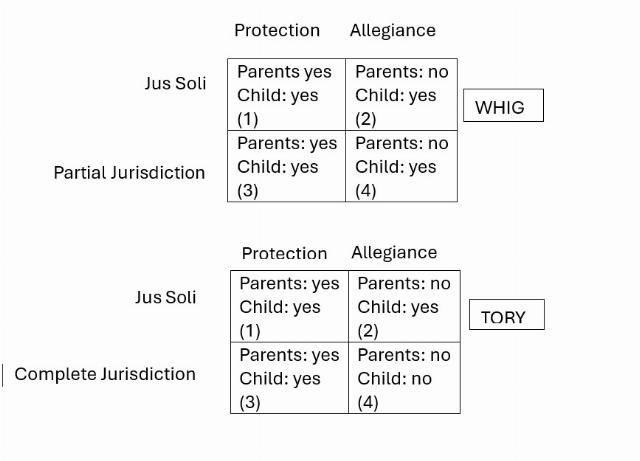
The diagrams represent contrasting schemes of territorial jurisdiction; one diagram represents partial jurisdiction, the other complete jurisdiction -- thus, two different conceptions of birthright citizenship. The "Whig" and "Tory" names are strictly for convenience; they aren't meant to be historically accurate.
 As can be seen by comparing boxes 1 and 3, it's uncontroversial that alien parents and their children born here are protected by criminal law, and by certain other American laws, such as due process. For the purposes of this article, we can ignore these two boxes.
As for box 2 of Tory, some people might want to replace the "yes" with a question mark. That's okay I have a hard time seeing the answer as a definite "no," however, because that would run up against common experience. Consider the hypothetical case of baby Juan, who is born in Kansas to illegals and whose unknown future includes serving honorably in the U.S. Army. Surely baby Juan's (future) allegiance counts for something. I've therefore left the ambivalence of a question mark out of Tory box 2, while admitting that it arguably persists in the background.
Now where the plot thickens is in box 4 in each conception, under "child." Is the kid rightly a natural-born citizen, or not? Whig has "yes," and Tory has "no." Notice that Whig is consistent in the allegiance column -- that is, in boxes 2 and 4 -- and Tory isn't. At first blush this seems to count strongly against Tory. (Even if box 2 of Tory contains not "yes" but a question mark, the inconsistency remains, albeit less sharply.) But Whig, it turns out, is inferior to Tory as a theory of birthright citizenship. For the five-justice majority on the constitutional question in Barbara, that's a serious philosophical problem, beyond judicial interpretation and even beyond jurisprudence.
Contrary to first appearances, the inconsistency in Tory doesn't vindicate the Court's judgment. It's true that the Whig conception of birthright citizenship, unlike the Tory conception, is consistent. But it's also incoherent and/or contradictory, which is much worse than mere inconsistency.
The problem is in Whig box 4. The Whig idea there, presumably, is that partial jurisdiction transmutes into complete jurisdiction by virtue of jus soli. But that makes no sense at all. Jus soli lacks the metaphysical chops to turn partial jurisdiction into complete jurisdiction, like the Holy Spirit turning communion wine into blood.
Now step back and view the terrain. Unless we agree with Justice Samuel Alito in rejecting the common law of jus soli entirely, we may have to regard the evident inconsistency in Tory as rationally irresolvable -- what Isaiah Berlin called a "conflict of [incommensurable] values." Here, the value to the country of the loyalty of people like baby Juan (in the above example) conflicts with the value to the country of having national borders. This sort of value conflict -- not to be equated with a debate about open borders -- can be rationally decided only on public policy grounds. It may be rationally undecidable by any legal principles.
The public-policy choices should be ones in which jurisdiction is prioritized over jus soli, the common law understood in the light of modern sovereignty -- which implies complete jurisdiction. Note that if we prioritized jus soli over jurisdiction, it would degrade jurisdiction, whereas prioritizing jurisdiction doesn't degrade jus soli.
The Whig view, centered as it is on partial jurisdiction, or what Chief Justice John Roberts misleadingly calls "jurisdiction in its ordinary sense," has a bizarre understanding of birthright citizenship, where the child is both under partial jurisdiction through his parents -- which supposedly makes it possible for him to be a native-born American in the first place -- and under complete jurisdiction by supposed birthright. It's almost comical how the Barbara Court meandered down the hapless road of "spooky metaphysics."
America must be a place where the rule of law still matters. (Hat tip, Sen. Elissa Slotkin.) In affirming, and even reifying, the birthright-citizenship status quo, the Supreme Court pits a merely inconsistent conception of birthright citizenship -- an inconsistency resolvable in practice by public policy decision-making (which by the way, everything in a democracy being deformed by sharia, need not put baby Mohammed and baby Juan in the same boat), and removable altogether by abolishing the common law of jus soli, as urged by Justice Alito in his dissent -- against an incoherent and/or contradictory conception, and absurdly decides in favor of the latter.
The Court makes birthright citizenship depend on irrationality. And thus also America's future.
Source link