
OAN Staff Brooke Mallory
11:58 AM – Saturday, August 1, 2026
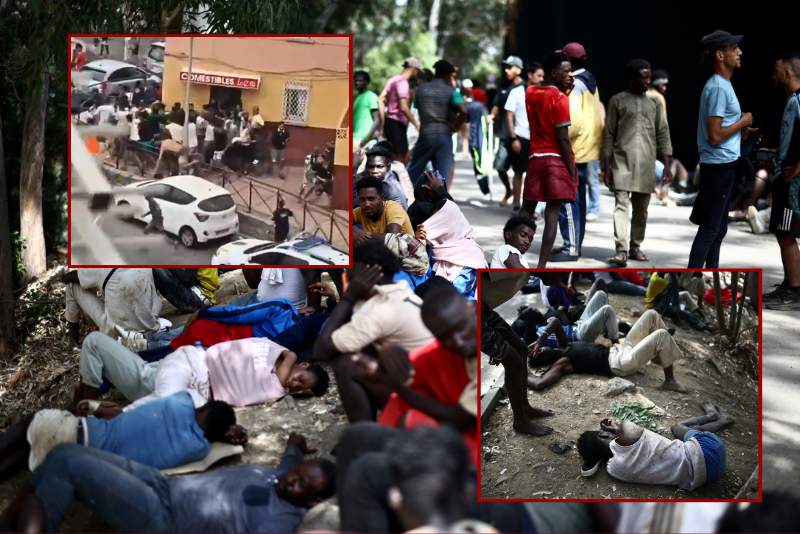
A massive border crisis has erupted in Ceuta, a Spanish enclave located on the North African coast, as an estimated 50,000 to 60,000 migrants forcefully crossed from Morocco into the small territory over a single 24-hour period.
The mass border breach first began on the morning of July 30th. The chaotic influx — equivalent to roughly 70% of the enclave’s total population of 85,000 — has continued to overwhelm local infrastructure and border security.
Spanish authorities have reported that thousands of individuals streamed across the border by swimming along the coast from Fnideq, climbing coastal breakwaters or pushing through perimeter checkpoints. At least 67 people have also lost their lives to drowning or in “human crushes” during the desperate crossing attempts.
The vast majority of the migrants involved originated from Morocco, primarily consisting of young men and unaccompanied minors from nearby northern towns like Fnideq as well as urban centers across the country.
In addition to Moroccan citizens, the region serves as a transit bottleneck for individuals hailing from across Sub-Saharan Africa — including nations such as Senegal, Mali, Guinea, Ivory Coast and Sudan — who make long, hazardous overland journeys through the Sahara to reach Morocco as a jumping-off point into Europe, alongside a smaller number of Algerian nationals.
🚨#BREAKING: The Moroccan Muslims who have invaded the small Spanish city of Ceuta are now BREAKING INTO STORES by the HUNDREDS.
— Matt Van Swol (@mattvanswol) July 31, 2026
Police are completely overwhelmed.
Migrants can be seen running from one store to the next, grabbing items and running.
WHERE IS THE MILITARY?!!!!! pic.twitter.com/NjqQAI4zgD
Following a recent ruling by the Spanish Supreme Court regarding summary deportations of migrants arriving by sea, human trafficking networks exploited the decision to claim online that the border was open and that passage into European territory would go unhindered.
Spanish Prime Minister Pedro Sánchez strongly condemned the human trafficking syndicates responsible for generating the surge, describing the incident as a grave violation of Spain’s territorial integrity.
On the ground, the Spanish government has also since installed a 500-meter floating sea barrier off the coast of Ceuta to physically block individuals from swimming around the Tarajal and Benzú breakwaters into Spanish territory.
Despite this, critics of Sánchez have consistently asserted that the government’s efforts just aren’t enough.
When your country needs a leader, but you voted for an influencer. https://t.co/fQyEe3SRMh
— Neo (@Realneo101) August 1, 2026
With local reception facilities and temporary centers completely saturated beyond capacity, the influx has triggered a severe humanitarian and sanitation crisis within the tiny outpost.
Civil Guard representatives and local officials have described scenes of “complete logistical collapse” as thousands of displaced migrants are still left roaming the city streets without access to basic shelter, food or clean water.
Meanwhile, public spaces, beach areas, plazas and city parks have become makeshift encampments where many are being forced to sleep on sidewalks and utilize public fountains and open areas for basic washing and sanitation due to the absence of public amenities equipped to handle a crowd of that magnitude.
JUST IN: 🇪🇸 Illegal immigrants set cars on fire after successfully breaching the Melilla border fence into Spain. pic.twitter.com/mrRIVA4A1l
— BRICS News (@BRICSinfo) July 31, 2026
Additionally, during border crossings and perimeter storming attempts along the Spanish-Moroccan frontier in Ceuta and Melilla, violent altercations have erupted frequently between border security forces and groups attempting to force entry.
These confrontations have resulted in hundreds of injuries on both sides, with dozens of Spanish Civil Guards and Moroccan police officers suffering stab wounds, cuts and blunt-force trauma.
However, although numerous social media videos accompanied by AI-generated-backed analysis surfaced online, Spain’s Interior Ministry subsequently refuted reports of stabbings as “misinformation,” alleging that no stabbing-related deaths occurred between July 30th and August 1st.
While Spanish officials have also tried to claim that the enclave has returned to “normality,” local reports and those on the ground have argued that this is simply not the case. Many individuals purportedly remain hiding in abandoned areas or wandering the city, while emergency operations and border security reinforcements remain active.
THIS is Marxism in practice: open borders, eroded sovereignty, and unlawful migration on a massive scale.
— Speaker Mike Johnson (@SpeakerJohnson) July 31, 2026
What’s happening in REAL TIME in Spain is EXACTLY the future the radical Left envisions for America. The socialists are ruining Spain just as they would the U.S.
We MUST… https://t.co/Tt5KFc0L8a
A number of security officials who wished to stay anonymous have labeled these most aggressive fence-scaling pushes as organized, violent assaults, while far-left human rights organizations have argued that the chaos and escalated force is due to Spanish law enforcement’s “cycle of violence” along the border.
In response to the emergency, the Spanish government has reportedly deployed even more armed forces personnel and extra national police units to assist local Guardia Civil officers, secure the perimeter and restore public order. Temporary processing centers were also quickly established to “register arrivals and initiate expedited expulsion procedures,” Spanish officials added.
Stay informed! Receive breaking news alerts directly to your inbox for free. Subscribe here. https://www.oann.com/alerts
What do YOU think? Click here to jump to the comments!