
Andy Burnham must ditch Labour's hard-Left workers' rights reforms or risk sending Britain back to the 1970s, the Tories warned last night.
The swingeing changes will make it easier for unions to ballot for strikes, which could leave the country in a state of paralysis.
Keir Starmer's government passed the Employment Rights Act last December but some of its most damaging elements will only be implemented in the coming months.
These include 'swipe to strike' proposals allowing online balloting for industrial action. Opponents warn the change, due to come in on August 31, coupled with looser balloting requirements, could trigger a wave of disruptive walkouts.
The measures also include doubling the time limit for most employment tribunal claims in the UK from three months to six months from October 1, while businesses face a raft of additional workplace obligations in the months ahead.
Critics say the package of reforms, spearheaded by Housing Secretary Angela Rayner before her resignation from Sir Keir's government, threatens to saddle employers with extra costs and bureaucracy just as many are grappling with rising taxes, stubborn inflation and weak economic growth.
The layers of red tape come when entrepreneurship is already in decline, with new figures showing the number of new businesses has slumped close to the lowest level in a decade.
And an Institute of Directors (IoD) poll of more than 500 bosses found that confidence remained subdued, with a 'modest deterioration' in July compared to the previous month.
Andy Burnham pictured on a run in Manchester yesterday. Swingeing workers' rights changes will make it easier for unions to ballot for strikes

Critics say the reforms, spearheaded by Housing Secretary Angela Rayner, pictured last month before her resignation from Sir Keir's government, could saddle employers with extra costs
Tory business spokesman Andrew Griffith branded the threat of yet more pro-trade union regulations an attempt to return to the Seventies.
Writing for this paper, he warned it will worsen the crisis of young people finding it impossible to find jobs. He said: 'I hope Labour will see sense, pause the implementation of this mad Act, repeal it, and cancel our very expensive trip back to the 1970s.
'If they don't, Conservatives certainly will. We will repeal all the job-killing measures in the (Un)Employment Rights Act, and we will go further to curtail the power of the unions in the public and private sector by ending the scandal of paid-for trade union time on the taxpayer.'

The number of working days lost to strike action under Labour has surged past one million despite handing bumper pay hikes to its union paymasters. Under current laws, strikes are balloted privately in workers' homes and must be completed and returned by post.
But this is set to change to allow workers to respond online, amid warnings it could lead to a rise of shop stewards intimidating staff to vote a certain way.
Conservative leader Kemi Badenoch has thrown down the gauntlet and called on Mr Burnham to ditch the hardline, job-destroying policies before it's too late.
She told the Daily Mail: 'The Employment Rights Act has been a total disaster for business and for jobs. Britain has a graduate recruitment crisis and rising unemployment in part because of this terrible legislation. If Andy Burnham wants to show he's serious about spreading growth around Britain, he'd stop the remaining parts of the Act coming into force.'
A suite of further rules and regulations is set to come into force throughout next year, including a major crackdown on zero-hours contracts that will force employees to be compensated for short-notice cancellations.
Unions will also be given the right to roam workplaces with 21 employees or more, as frequently as once a week, to recruit members and hold talks and meetings.
And from October 30 this year, ministers are set to enact a 'banter ban' which will see pub landlords forced to police comments made by customers that could offend staff.
The law has already come under fire from former Labour Cabinet minister Alan Milburn, who was tasked by Sir Keir to come up with a solution to the youth unemployment crisis.
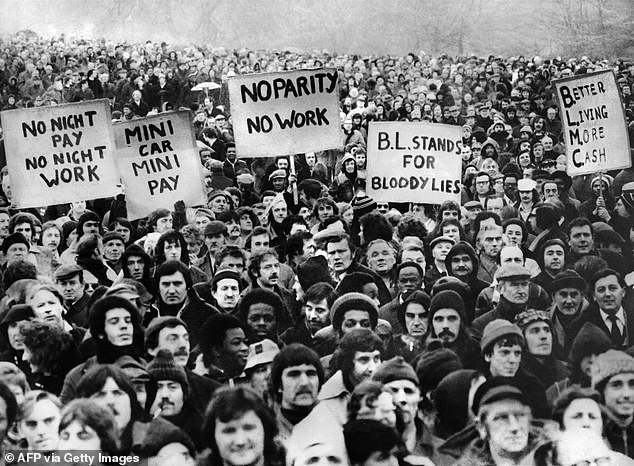
The PM must ditch Labour's workers' rights reforms or risk sending Britain back to the 1970s, Tories warned (Pictured: British Leyland workers from Longbridge plant demonstrate in 1979)
Will easing strike laws and boosting union powers protect workers or threaten Britain's economy?
His report warned: 'Employment Rights Act reforms, while intended to strengthen worker protection, were seen by some employers as increasing the burden of managing underperformance and reducing flexibility.'
The Conservatives' demands came as new figures revealed a damning slump in new business openings.
According to the Office for National Statistics, the first six months of 2026 saw 157,980 new businesses created, down 3 per cent on the same period last year. This is just above the lowest figure for the decade, set in 2023.
A Government spokesman said: 'We continue to consult with business and unions on implementation of the Employment Rights Act, to ensure the system is fair and effective for employers while protecting the workers who need it most.'