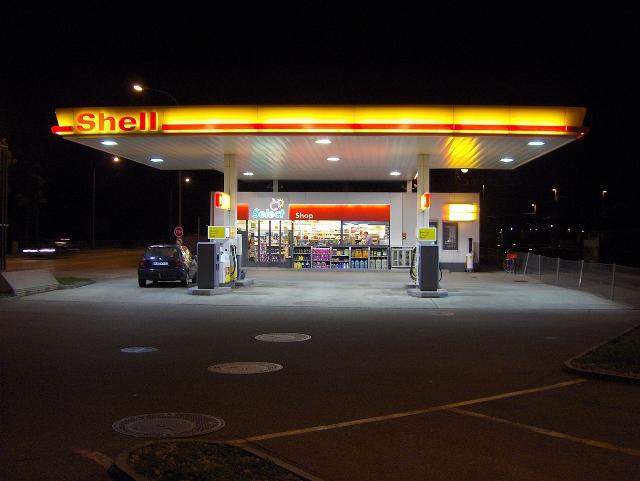
Gas prices are rising again in Germany. The main culprit is the state with its towering levies. In the EU, a mechanism has become established that artificially restricts and drives up the cost of energy in order to tax it more effectively afterward.
Holiday season is travel season. Once out on the road, many German tourists experience a nasty surprise at the gas stations of their destination or while passing through: Whether in Austria, Poland, Italy, or Spain -- filling up here is sometimes 25 to 40 percent cheaper than at home. The reason is the systematic tax rip-off by the German Treasury. Germany is, after all, a frontrunner in this area -- up to 55 percent of the price of gas flows from the pump into state coffers.
Rising fuel prices please the chief treasurer of the debt disaster, Lars Klingbeil. In Berlin, people do not think in large cycles and broad lines -- what matters is the quick euro. Consumers are both a milking cow and political disposable asset -- there is nothing left to be seen of the ideal of the sovereign citizen who was supposed to be freed from fiscal overload and overregulation in the current political climate.
The gas pumps of German filling stations mark the point of harvest of a policy that has forged a perfidious, but quite sophisticated, extraction scheme out of society's dependence on fossil fuels.
Put plainly, one could say: the regulator-driven reduction of refinery capacity in the EU, the forced CO2 levy through the certificate scheme, the artificial increase in the cost of energy imports through the CBAM carbon mechanism -- every individual measure taken by Brussels fits into a machinery designed to artificially restrict and thereby drive up the price of fossil fuels in the EU. In this way, a kind of cost-push inflation is generated, which initially expands the nominal tax base.
The EU operates quite subtly within its scheme, concealing the numerous levers at its disposal behind an impenetrable propaganda fog of climate apocalypticism and nonsensical rhetoric about progress. Climate technology is good. It will only cost one scoop of ice cream to deindustrialize Germany with towering energy costs, or however the story went.
At the CBAM carbon border mechanism, the Euro strategy can be studied in detail: The goods primarily affected are carbon-intensive products such as steel, cement, aluminum, hydrogen, fertilizers, and imported electricity. These essential intermediate goods for industrial production and power-generation capacity are made more expensive in this way and later feed indirectly into prices through production and logistics infrastructure. Then the state strikes again – with higher consumption taxes.
 All this sounds like a fairy tale from a state dystopia. Brussels first takes its cut at the CO2 level, making goods more expensive along the value chain, where the national taxman then lies in wait again and again to take his share at several stages of the value chain. A perfidious, destructive extraction scheme that strikes at the most sensitive point of economic activity, where in principle neither consumers nor producing businesses have alternatives. You pay. Some have to stay in business, while others grit their teeth and accept the inflation provoked by politics.
Let us call a spade a spade: The EU taxpayer has been strapped to a fiscal rack.
The chancellor's call for an increase in VAT therefore seems almost cheeky. No one can escape it – it is the endpoint of all the levies previously paid, at the income level, at the capital-gains level, right through to the indirect payments via the CO2 mechanism described above.
Another example from everyday tax practice is domestic air travel. There, taxes and charges -- consisting of the aviation tax, aviation-security and airport fees, as well as regular VAT -- amount on average to around 50 to 70 percent of the ticket price.
This example is also instructive because, on closer inspection, it gives an impression of how frequently the state actually takes its cut along a particular value chain. The cost chain begins at the company level: with the purchase of aviation fuel, through airport fees, take-off and landing charges, and CO2 certificate costs, all the way to the aforementioned taxation of air tickets. The absolute levies become higher the more costs regulatory policy has already generated in logistics at the company level – costs that later have to be passed on to the end consumer.
For European consumers and businesses, things will get tough from 2027 onwards. The emissions trading system will then be extended under ETS2 to the transport sector and heating -- with an estimated surcharge of 25 cents per liter at the outset, rising to as much as 50 cents by 2030. A rich haul for Brussels, which is thus opening up new sources of revenue. The Brussels regulatory apparatus is not only large in terms of personnel; it is also extremely inventive when it comes to fleecing citizens.
With the biofuel quota (E10 blending requirement), the EU obliges oil companies to blend bioethanol and biodiesel, which makes fuel more expensive and, in turn, contributes through the corresponding leverage effect to growing tax revenues.
Anyone who complains about the sluggishness of the EU bureaucracy is in for a surprise. With the diligence of bees, the bureaucratic machine is working to open up new wells from which to extract, in fiscal terms, whatever has not yet been tapped.
In addition to the fiscal haul, the EU is pursuing a scorched-earth policy: With the previously mentioned reduction in refinery capacity from 18.3 to just 15.1 million barrels per day, refinery costs within the EU are rising massively. In emergencies such as a closure of the Strait of Hormuz, the European economy is then left out in the cold. It is dependent on emergency imports and has to submit to the pricing power of exporters.
That consumers and businesses are left out in the cold is politically intended. They are prisoners of a perfidious, tightly constructed fiscal matrix that may be effective in the short term, but in the long term destroys the economic foundation that sustains it itself.
Image: Blademaster88
Source link